I grew up around chicory fields. Not metaphorically – literally. My family has been farming in Gujarat’s Charotar region for over a century, and chicory has been part of that story for as long as I can remember. When we established Vashila Industries and built our processing facility near Nadiad, we didn’t pick the location randomly. We set up right in the middle of what is arguably the finest chicory-growing belt in the world.
People in the global chicory trade often talk about Belgium and France as the traditional powerhouses. And they’re right – Europe built the inulin extraction industry. But when it comes to root quality, flavour intensity, and year-over-year consistency, Gujarat has earned its place at the table. And honestly, for certain product categories – roasted chicory powder, dried roots, chicory cubes – Gujarat-origin chicory is what international buyers specifically request.
This isn’t just regional pride talking. There are real, measurable agronomic reasons why chicory grown in this belt produces roots with higher inulin content, stronger pungency, and better processing characteristics. Let me walk you through them.
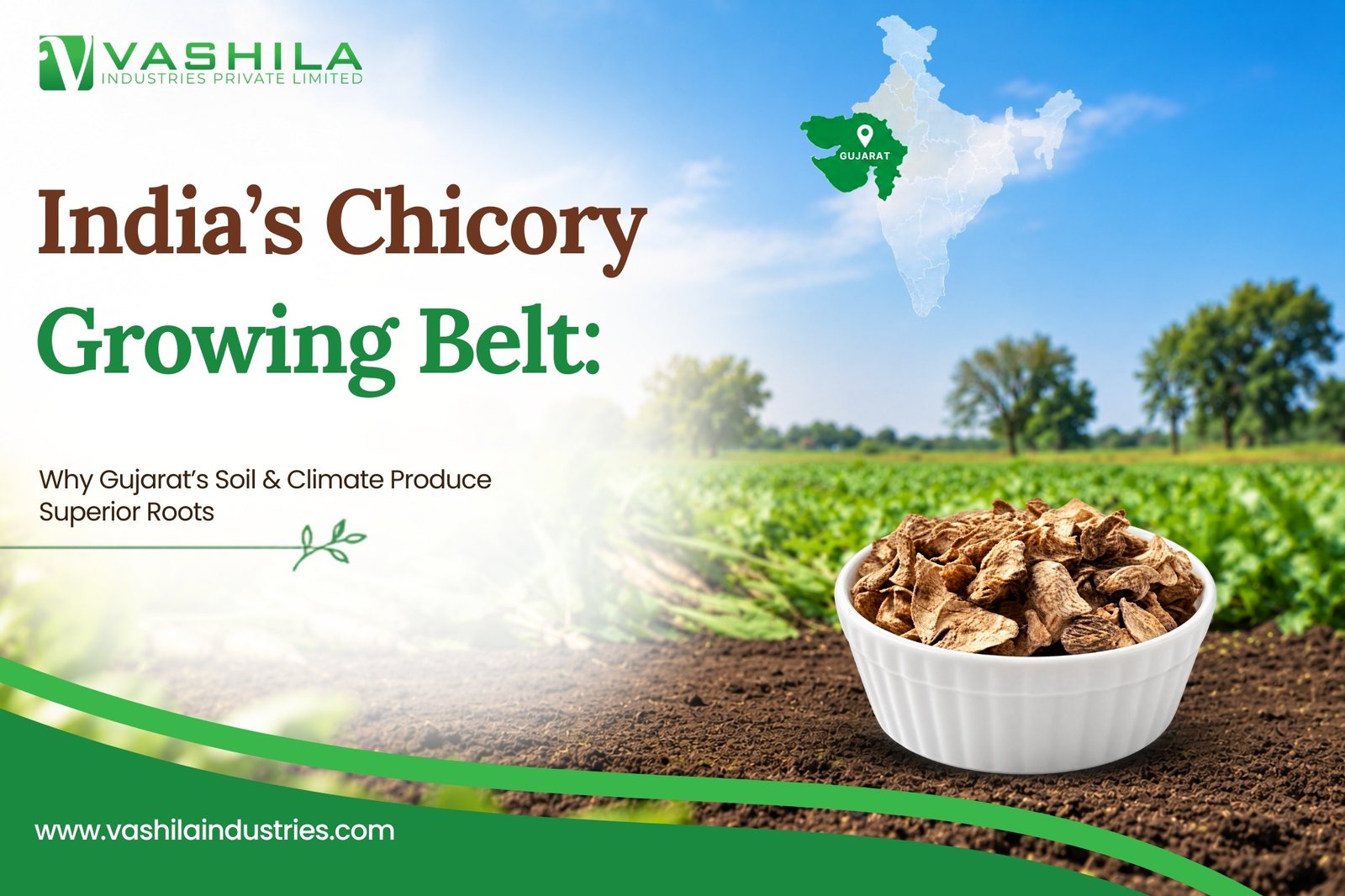
Where Exactly Is India's Chicory Belt?
India’s chicory production is concentrated in two states – Gujarat and Uttar Pradesh – which together account for roughly 97% of the country’s total output. But within Gujarat, the cultivation is clustered in a handful of districts that form what the industry informally calls the “chicory belt.”
The Key Districts
District | Region / Notable Areas | Known For |
Anand & Kheda | Charotar region, Nadiad, Petlad | Traditional chicory heartland; fertile alluvial soil |
Jamnagar | Coastal Saurashtra | High-pungency roots; strong export output |
Mehsana | North Gujarat | Large-scale commercial farming |
Banaskantha | Dhanera and surroundings | Expanding cultivation area |
Patan | North Gujarat plains | Growing chicory acreage |
Our facility at Vashila Industries sits near Nadiad – right on the Kanjari Highway Bypass – which puts us at the geographic centre of this belt. The chicory fields that supply our raw material are, in many cases, less than a two-hour drive from our factory door. That proximity isn’t just convenient. It’s a quality advantage I’ll explain shortly.
The Soil Factor: Why Gujarat's Earth Grows Better Roots
If I had to pick the single biggest reason Gujarat chicory outperforms, it would be the soil. Everything starts there.
Sandy Loam – The Perfect Texture
Chicory is a taproot crop. The edible part – the root – grows 30 to 35 cm straight down into the earth. If the soil is hard, compacted, or full of stones, the root can’t develop properly. It forks, it stunts, it struggles. You end up with small, misshapen roots that yield less inulin per kilogram and are harder to process.
Gujarat’s chicory belt – particularly the Charotar region around Anand, Kheda, and Nadiad – is blessed with deep, fertile, sandy loam soil. This soil type is loose, crumbly, and incredibly well-drained. It offers virtually no resistance to the growing taproot, allowing it to develop into a long, straight, uniform shape that’s ideal for both drying and roasting.
I’ve visited chicory farms in Uttar Pradesh – the other major growing state – and while UP produces good chicory, the soil tends to be heavier. More clay content. More compaction. The roots are often shorter and thicker, which affects the drying ratio and the final product consistency.
Natural Sulfur Content
Here’s something that doesn’t get talked about enough. Gujarat’s soil – especially in the Jamnagar and Saurashtra belt – has a naturally higher sulfur content compared to most other chicory-growing regions in India.
Why does that matter? Because sulfur is directly linked to the pungency and flavour intensity of the chicory root. Sulfur-containing compounds are part of what gives roasted chicory its characteristic deep, complex, slightly bitter aroma – the flavour that coffee blenders pay a premium for.
When we roast Gujarat-origin chicory into our roasted chicory powder or roasted chicory granules, the flavour profile is noticeably bolder and more developed than chicory from regions with lower-sulfur soils. International coffee brands who have tasted both side by side almost always prefer the Gujarat product. That’s not subjective marketing – it shows up in sensory evaluation panels.
Drainage – The Silent Hero
Chicory hates wet feet. If the root sits in waterlogged soil for even a few days, it starts to rot. Fungal infections set in. The inulin content drops because the plant shifts its energy from storage to survival.
Gujarat’s sandy loam drains beautifully. Even after heavy irrigation or unexpected late-season rain, the water moves through the soil profile quickly. The roots stay healthy, the fungal pressure stays low, and the harvest comes in clean.
Compare that to regions with heavier clay soils where drainage is poor, and you understand why Gujarat farmers consistently report lower crop loss rates and cleaner root harvests than growers in other parts of the country.
The Climate Factor: Cool Winters, Warm Days, Perfect Timing
Chicory is a rabi (winter) crop in India. It’s sown in November and harvested between February and March – roughly a 120 to 135-day crop cycle. And Gujarat’s winter climate hits almost every agronomic sweet spot this plant needs.
Temperature Range
Growth Phase | Ideal Temperature | Gujarat Winter Reality |
Germination | ~25°C | November days: 28–32°C |
Vegetative growth | 10–20°C | Dec–Jan nights: 8–15°C, days: 22–28°C |
Root bulking | 10–15°C (cool nights critical) | Jan–Feb nights consistently in this range |
Pre-harvest maturity | Moderate, no extreme heat | Feb harvest before March heat sets in |
The magic of Gujarat’s climate for chicory is the cool nights during December and January. When nighttime temperatures drop to 8–15°C, the plant slows its above-ground growth and channels energy into the root. This is when inulin accumulates most aggressively. Longer, cooler nights mean more inulin packed into each root by the time harvest arrives.
I’ve seen this play out season after season. Years when December and January are unusually warm – fewer cool nights, higher nighttime minimums – the roots come in lighter, with measurably lower inulin content. Years with a proper cold winter? The roots are dense, heavy, and test beautifully in the lab.
Frost Tolerance Without Frost Damage
Here’s something interesting about Gujarat versus, say, Belgium or Northern France. In European chicory regions, the crop faces genuine frost risk – temperatures regularly drop below 0°C, and hard frosts can damage the root crown and trigger premature bolting.
Gujarat’s chicory belt rarely sees frost. The coldest nights might touch 5–6°C in the open fields around Nadiad and Anand, but actual frost events are extremely rare. This means the crop gets all the benefits of cool temperatures – enhanced inulin synthesis, reduced pest pressure, slower fungal growth – without the downside of frost damage.
It’s a Goldilocks zone. Not too hot, not too cold. Just right for chicory.
Low Humidity During Harvest
This one gets overlooked but it matters enormously for post-harvest handling. When you pull chicory roots out of the ground in February, you need to wash them, slice them into cubes, and dry them – fast. Any delay between harvest and drying causes the inulin to start breaking down into simple sugars. Mould can set in. Quality degrades rapidly.
Gujarat in February is dry. Relative humidity is typically 30–45%. Sunshine is abundant. This makes field-level sun drying effective and quick, and it means the roots arrive at our processing facility in Nadiad in excellent condition – clean, firm, and full of intact inulin.
Try harvesting chicory in a high-humidity coastal region or during monsoon season, and you’ll understand why timing and climate matter so much.
The Farming Practices That Make a Difference
Having great soil and climate is necessary but not sufficient. How the crop is actually grown – the farming practices – determine whether you get average roots or exceptional ones.
Line Sowing Over Broadcasting
Traditional chicory farming in India used to rely on broadcasting – scattering seeds across a ploughed field. It’s cheap and fast, but it produces uneven plant spacing. Some areas are overcrowded (small, competing roots), others are sparse (wasted land).
Modern chicory farming in Gujarat – including on our own and contract farms – uses line sowing or ridge-and-furrow planting. Seeds are placed in evenly spaced rows (approximately 45 cm between rows, 8–10 cm between plants). This gives each root enough space to grow to its full potential, allows for mechanised irrigation and weeding, and produces a more uniform harvest.
The difference in root size and uniformity between a broadcast field and a line-sown field is dramatic. Buyers who need consistent raw material for dried chicory roots or chicory cubes notice this immediately.
Harvest Timing – The Inulin Window
There’s a narrow window – roughly two to three weeks – when the chicory root is at peak inulin content. Harvest too early, and the root hasn’t finished accumulating inulin. Harvest too late, and the plant starts mobilising its stored inulin to fuel new leaf growth as spring temperatures rise.
Our agronomists monitor the crop weekly during January and February, checking for the telltale signs: leaves turning yellowish, roots reaching full diameter, and field samples testing at target inulin levels. When the timing is right, we coordinate harvest across our contract farms so that roots reach our Nadiad facility within 24 to 48 hours of being pulled from the ground.
That speed matters. Inulin starts degrading the moment the root leaves the soil. Enzymes inside the root begin converting inulin into fructose and glucose. The faster we get from field to processing line, the more inulin we preserve in the final product – whether that’s dried roots, roasted cubes, or chicory extract.
Crop Rotation for Soil Health
We don’t grow chicory on the same field year after year. Our farms follow a rotation cycle – chicory in the rabi season, followed by a kharif crop like groundnut, cotton, or a cover crop. This prevents soil exhaustion, breaks disease cycles, and maintains the nutrient profile that chicory roots need.
Farms that grow chicory on the same plot every season see declining yields and increasing pest problems within three to four years. Rotation avoids that entirely.
Gujarat vs Other Growing Regions - An Honest Comparison
I want to be fair here. Gujarat isn’t the only place in the world that grows good chicory. But it has specific advantages that are hard to replicate elsewhere.
Factor | Gujarat (India) | Uttar Pradesh (India) | Belgium / France (Europe) |
Soil type | Sandy loam – ideal drainage and root development | Heavier clay-loam – decent but more compact | Varies – generally good but heavier in some regions |
Sulfur content | Naturally high (especially Saurashtra) | Moderate | Moderate to low |
Winter temperature | 8–15°C nights (perfect for inulin) | Similar but with more fog and humidity | Colder – frost risk is real |
Humidity at harvest | Low (30–45% RH) | Moderate to high | Variable – rain risk during harvest |
Post-harvest speed | Fast – processing facilities nearby | Moderate – roots often transported long distances | Fast – well-integrated supply chains |
Labour cost | Low | Low | High |
Processing infrastructure | Extensive – Gujarat is India’s chicory processing hub | Limited – most roots shipped to Gujarat or South India for processing | Very advanced – decades of extraction R&D |
Inulin content (dried root) | 35 – 45% | 30 – 40% | 35 – 45% (optimised cultivars) |
The takeaway? Gujarat matches European chicory regions on root quality and inulin content, while offering significant advantages on cost, harvest conditions, and supply chain proximity. And it decisively outperforms UP on soil drainage, humidity, and processing infrastructure.
From Our Fields to Your Factory - The Vashila Industries Connection
Everything I’ve described in this article – the soil, the climate, the farming practices, the post-harvest speed – feeds directly into what happens inside our 35,000 sq ft processing facility near Nadiad.
Our family has farmed in this region for over a century. When we established Vashila Industries and transitioned into processing in 2012, we didn’t have to learn the raw material from scratch. We already knew which fields produced the best roots, which varieties delivered the highest inulin, and which farming practices led to consistent, export-grade quality.
Today, we process Gujarat-grown chicory into the full range of products:
- Dried Chicory Roots – raw material for extraction and health beverages
- Roasted Chicory Root – whole roasted for coffee blending
- Dried Chicory Cubes & Roasted Chicory Cubes
- Roasted Chicory Powder – light, medium, dark roast profiles
- Instant Chicory Powder – spray-dried for full solubility
- Roasted Chicory Granules
- Chicory Extract – liquid and grain formats, up to 90% inulin
- Unroasted Chicory Flour – for baking and fibre fortification
Every product starts with roots grown in the soil I’ve described, harvested in the climate window I’ve explained, and processed within hours at our Nadiad facility. That farm-to-factory proximity – often less than two hours from field to processing line – is something very few chicory processors in the world can match.
Our facility holds FSSAI, ISO, HACCP, FDA, Kosher, and Halal certifications. Every batch is lab-tested for inulin content, moisture, colour, and microbiological safety. Full Certificate of Analysis included with every shipment.
The Bottom Line
Soil, climate, and proximity. Those three words explain why Gujarat has become the centre of India’s chicory industry – and why international buyers increasingly specify Gujarat-origin chicory for their most quality-sensitive product lines.
When you source from Vashila Industries, you’re not just buying a product. You’re buying the output of a specific geography – one that happens to be uniquely suited to growing chicory. Sandy loam soil that lets roots grow deep and straight. Cool winter nights that pack those roots with inulin. Dry harvest conditions that keep quality intact from field to factory. And a processing facility in Nadiad that turns those roots into finished products within hours of harvest.
That’s not something you can replicate by setting up a factory somewhere else and importing roots. The advantage is in the ground itself.
Frequently Asked Questions
-
Where is chicory grown in India?
Chicory is primarily grown in Gujarat and Uttar Pradesh, which together produce about 97% of India's chicory. Within Gujarat, the main growing districts are Anand, Kheda (including Nadiad), Jamnagar, Mehsana, and Banaskantha. Gujarat is also the hub for chicory processing, with major facilities concentrated in the Anand-Kheda-Nadiad corridor.
-
Why is Gujarat chicory considered superior?
Gujarat's chicory belt offers an ideal combination of sandy loam soil (excellent drainage, deep root development), naturally high sulfur content (stronger flavour and pungency), cool winter nights (8–15°C, perfect for inulin accumulation), and low humidity at harvest time (clean, fast post-harvest handling). These factors produce roots with consistently high inulin content (35–45% dry weight) and superior flavour.
-
What season is chicory grown in India?
Chicory is a rabi (winter) crop in India. It's sown in November and harvested between February and March, with a total crop cycle of approximately 120–135 days.
-
How much inulin does Gujarat chicory root contain?
Gujarat-grown chicory roots typically contain 35–45% inulin on a dry weight basis, which is comparable to European-grown chicory. The exact percentage varies by variety, harvest timing, and growing conditions. Vashila Industries tests every batch for inulin content and provides documented results in the Certificate of Analysis.
-
Where is Vashila Industries located?
Vashila Industries is located near Nadiad, Gujarat, on the Kanjari Highway Bypass. Our 35,000 sq ft processing and storage facility sits at the geographic centre of India's chicory growing belt, with most of our supplying farms within a two-hour drive.
-
Can I visit the Vashila Industries facility?
Yes. We welcome factory visits from prospective buyers and existing partners. You can see our processing lines, meet our quality team, and tour the nearby chicory fields during harvest season (January–March). Contact us to arrange a visit.