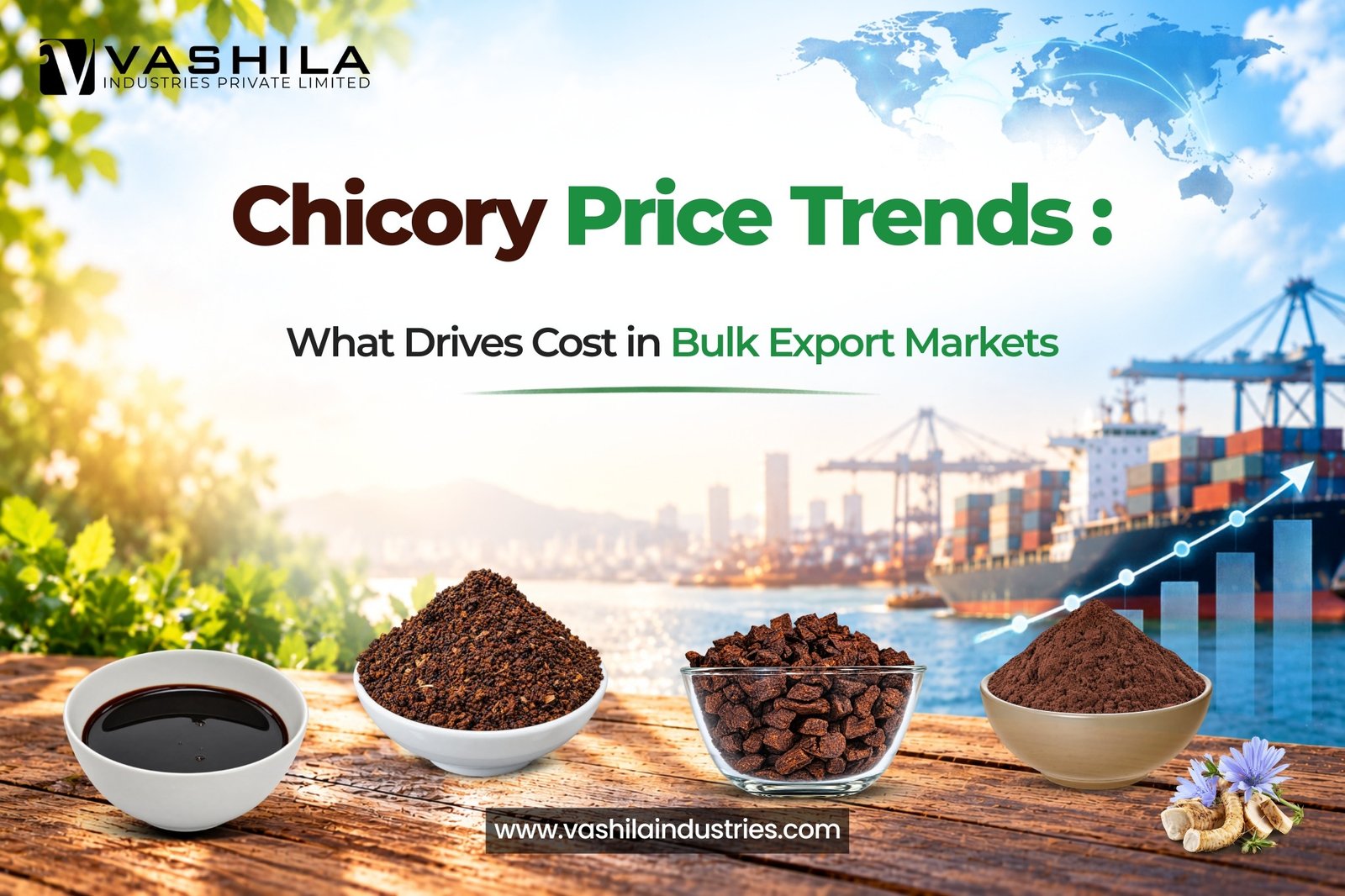
If you buy chicory in bulk, you’ve probably noticed that two quotes for “chicory” can sit far apart. One supplier says one number, another says double, and both sound reasonable. That’s normal, because chicory isn’t one product. It’s dried roots, roasted cubes, powders, extracts and flours, each with its own cost story.
We can’t give you a price list in a blog post, and we won’t pretend there’s a public chicory price index, because we haven’t found one. What we can do is walk through the things that push cost up or down, and back each point with data we could check. Where a number is an estimate, we say so.
Start with the size of the market
Trade in dried or processed chicory root is small. Data on the commodity code for chicory roots (HS 121294) puts world exports at just over $21 million in 2023, from 27 reporting countries. Hungary held about 40% of that (around $8.81 million), Belgium 14%, India 12.9% (around $2.84 million) and Poland 12.4% [2].
India’s own numbers line up. An industry data service estimates India shipped about 3,000 tonnes of chicory in 2024, worth $2.6 million, which is 10.7% less in volume than the 2023 peak. The average export price was $869 per tonne on an FOB basis, up 1.6% on 2023 but below the $1,021 per tonne peak of 2019 [1]. These are estimates from a data provider, not price quotes, and the source doesn’t say exactly which products they include [1].
A quick word on FOB. It means the seller’s price covers getting the goods onto the ship at the origin port. Ocean freight, insurance and import costs come on top. When you compare quotes, check that both use the same terms, or you’ll be comparing different things.
Europe is a much bigger picture because of its processing industry. One estimate puts 2024 European chicory production at about 572,000 tonnes, with Belgium making 454,000 tonnes (79%), on roughly 14,000 hectares harvested at about 42 tonnes per hectare [3]. The same report puts European consumption at about 566,000 tonnes, almost the same as production, so the export market is a small slice of the whole [3].
Our reading: a market this small has few buyers and sellers, so prices don’t move like a big traded commodity. That’s our interpretation, not something the sources state.
Driver 1: how much root an acre gives you
Everything starts in the field. In a poster from the Iranian Congress of Agronomy and Plant Breeding, researchers compared six chicory cultivars for inulin production. Inulin percentage differed by about 30% between genotypes, but fresh root yield differed by about 300%. The authors concluded that yield is the more promising trait to work on [4].
The practical lesson is simple. Anything that changes how many tonnes a farm produces changes the cost of each tonne, and yield varies far more than quality does. We do contract farming near Nadiad in Gujarat based on the quantity a buyer needs, so volumes can be planned ahead. Whoever you buy from, ask where the root is grown and how volumes are planned.
Driver 2: you’re mostly buying and shipping water
Fresh chicory root is wet. In one study of dried-root processing, the fresh samples held 79.25% moisture, and the authors note that roots must be dried for long-term storage because fresh roots deteriorate [5]. Do the arithmetic: 100 kg of fresh root holds only about 21 kg of dry matter.
That’s why bulk chicory trades dried, and why moisture is one of the first numbers worth checking on a spec sheet. Our dried chicory roots and dried chicory cubes are where that starts.
Driver 3: the form you choose
Each step from root to finished ingredient adds cost and loses some material.
Roasting alone is tricky. One patent notes that it’s hard to control: smaller pieces roast faster and end up darker or burnt, while larger pieces can be darker in the core than outside [6]. Extraction and drying come next. In that patent’s own example, kiln-dried chicory (about 90% dry matter) was extracted with 80 to 90 °C water, and 120 kg of root gave about 70 kg of powder, roughly 58% [6]. The same document says drying roast chicory extracts lowers spray-drying tower capacity, and long runs can cause build-up inside the tower and material losses [6].
That’s one inventor’s example, not an industry average, but it shows the point: every processing step has a yield and an energy bill. So the form you pick affects the price, whether it’s roasted chicory cubes, instant chicory powder or chicory extract. Ask for a quote on each form you’re considering rather than assuming an order. For the extract, also check solids content: ours is listed at a minimum of 65% total solids, and the rest is water.
Driver 4: the spec, not just the name
Two products can both be called chicory and still be different goods. Raw chicory root holds 70 to 94% inulin on a dry-weight basis [5]. After conventional roasting and extraction, one patent says soluble roasted chicory contains only about 18 to 19% inulin, never more than 20%, because heat and moisture turn inulin into fructose [7]. That’s the applicant’s description, not independent testing, so check an actual assay.
The spread in trade data hints at the same thing. The same European report that gives an average import price of $1,478 per tonne also lists a high of $3,512 per tonne for Poland and a low of $593 for Austria [3]. We can’t say from the report what’s behind the gap, but differences in what’s being traded is a likely part of it.
So when you compare quotes, ask for the specification: roast level, moisture, inulin or sugar content, particle size and the test method. Our chicory products are lab tested for purity, moisture content, extractability and sugar levels, and you can ask for the Certificate of Analysis for your lot. A cheaper quote with a looser spec isn’t a cheaper product.
Driver 5: destination and shipment size
Price depends on where the goods go. India’s 2024 exports went mostly to Hungary (766 tonnes), the United States (694 tonnes) and Germany (395 tonnes) [1]. Germany had the highest average price at $1,005 per tonne, while South Africa was among the lowest at $583 per tonne [1]. Freight distance, import duties, buyer requirements and product mix could all explain that, but the source doesn’t say which.
Shipment size matters too. Our listed minimum for the powders is 13 MT per container, and one 20 FT container (roughly 13 MT) for export extract orders. Order size and packaging are part of the quote, because they shape how freight is priced. Our page lists customised packaging and bulk supply, so tell us what you need.
Driver 6: ocean freight swings
Freight is the cost that moves fastest. The Drewry World Container Index, which tracks container rates on eight major East-West trade lanes, stood at $4,485 per 40 ft container on 15 October 2026, up 3% on the week after three weeks of falls [8]. Look at how far it can swing in a short time. In early April 2024 it was $2,929 [10]. By early June 2024 it had reached $4,716, a 12% jump in a single week [9]. That’s about 61% higher in roughly nine weeks.
One caution. Drewry’s index isn’t an India lane and doesn’t cover chicory. We’re using it only to show how fast sea freight can change. Ask your supplier or forwarder for the rate on your own route.
A note on currency
Trade data in the sources above is reported in US dollars [1][2]. If your quote is in one currency and the seller’s costs are in another, exchange-rate moves between the order and the payment can change what the deal is worth to either side. We haven’t tracked rate data for this article, so check the current rate with your bank.
Putting it together
| What moves the price | What the sources show |
|---|---|
| Root yield | Yield differed about 300% between cultivars; inulin only about 30% [4] |
| Water content | Fresh root about 79% moisture, so drying is essential [5] |
| Processing | Roasting is hard to control; extract and powder add drying losses [6] |
| Specification | Raw root 70 to 94% inulin; conventional roasted powder under 20% [5][7] |
| Destination | 2024 India export prices ranged from $583 to $1,005 per tonne by market [1] |
| Freight | Container index up about 61% in nine weeks in 2024 [9][10] |
How to compare quotes without getting burned
- Write the spec before you ask for a price: form, moisture, roast, inulin or sugar target, particle size.
- Ask for the Incoterm (FOB, CIF and so on) on every quote.
- Request a sample and a Certificate of Analysis. Our free sample form lets you pick the product and describe your needs.
- Get your own freight quote for your route.
- Ask how long the price holds and what happens if freight moves.
- Plan volume around the container size, not the other way round.
Common questions
Is there a public price for chicory I can check?
We haven’t found one. The best public figures are trade-data estimates, like the $869 per tonne average FOB price for India in 2024, and they mix products together [1].
Why did the price of India’s exports fall from 2019?
The average export price was $1,021 per tonne in 2019 and $869 in 2024 [1]. The source doesn’t give the reasons, and we won’t guess.
Which chicory form is cheapest?
We can’t say from public data. Each processing step adds work and some material loss [6], but the final price also depends on spec and volume, so ask for quotes on each form and test samples.
Where to go next
Browse our full chicory range, read the chicory guide on our blog, or send your requirements through the contact page. You can also learn more about us.
This article is general information, not a price quote or financial advice. Prices change, so get a current quote for your order.
References
- IndexBox. India: chicory exports 2024 (market analysis, March 2, 2025). https://www.indexbox.io/blog/india-chicory-exports-2024/
- Trendeconomy. World merchandise exports and imports by commodity, HS 121294 (chicory roots). https://trendeconomy.com/data/commodity_h2/121294
- IndexBox. Europe: chicory market overview 2024 (January 18, 2026). https://www.indexbox.io/blog/chicory-europe-market-overview-2024-5/
- Comparison of root chicory (Cichorium intybus L.) cultivars for inulin production in Iran. Poster, 15th Congress of Agronomy and Plant Breeding of Iran. https://icsc.areeo.ac.ir/article_22966.html
- Ahrabi F, Ghassemzadeh HR. The effect of low pressure oven drying of chicory root on quality and extraction time of inulin. Biomechanism and Bioenergy Research. 2022;1(2):61–64. https://doi.org/10.22103/bbr.2022.20514.1028
- US Patent 5,958,497. Chicory extract powder products and extract production processes and apparatus. https://patents.google.com/patent/US5958497
- US Patent 7,364,764 B2. Soluble roasted chicory having high inulin content. https://patents.google.com/patent/US7364764
- Drewry. World Container Index, assessment of 15 October 2026. https://www.drewry.co.uk/supply-chain-advisors/supply-chain-expertise/world-container-index-assessed-by-drewry
- Hellenic Shipping News. Drewry: World Container Index up 12% last week, 181% versus 2023 (June 2024). https://www.hellenicshippingnews.com/?p=1043135
- The Logistics World. Drewry container index (April 3, 2024). https://thelogisticsworld.com/actualidad-logistica/drewry-container-index-se-mantiene-a-la-baja