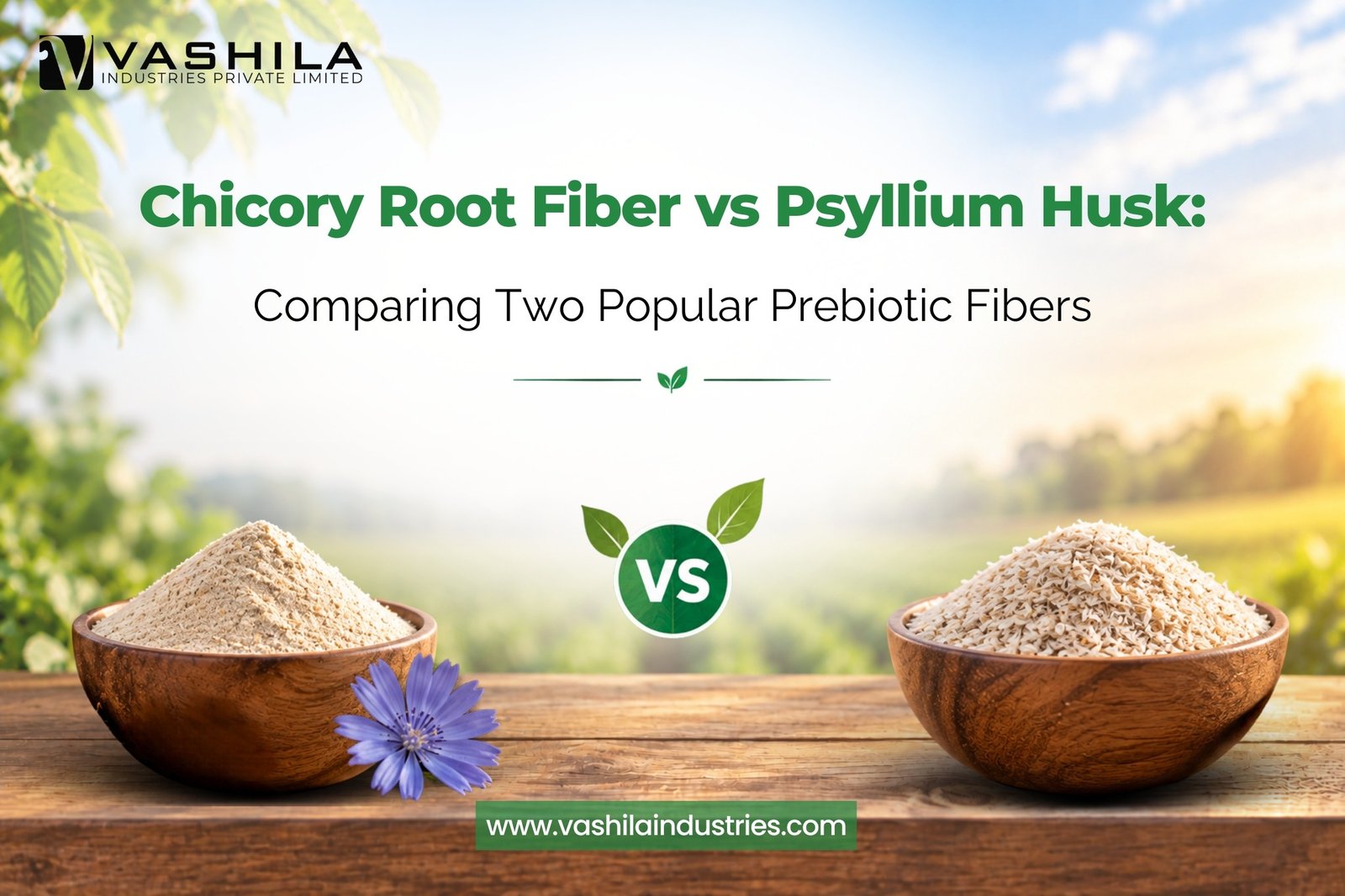
A few weeks ago, a supplement brand in the US sent me a brief that read something like: “We’re launching a gut health powder. We’ve narrowed the fiber base to two options – chicory root inulin or psyllium husk. Help us decide.”
My honest first reaction? These two aren’t even in the same category. Comparing chicory root fiber to psyllium husk is a bit like comparing a probiotic yoghurt to a glass of water. Both are good for digestion. Both are fibers. But they work in completely different ways, they feel different in your gut, and they do different things in a food formulation.
And yet, I get this comparison question constantly – from supplement formulators, functional food brands, beverage companies, even from buyers at Vashila Industries who are sourcing our chicory extract for the first time and want to understand where it fits in the fiber landscape.
So let me lay it all out. What each one does, how they’re different, where each one shines, and which one actually makes sense for your product.
The 30-Second Version
If you’re in a rush, here’s the core difference:
- Chicory root fiber (inulin) is a prebiotic. It feeds the beneficial bacteria already living in your gut. Think of it as fertiliser for your microbiome.
- Psyllium husk is a bulk-forming fiber. It absorbs water, swells into a gel, and physically moves things along your digestive tract. Think of it as a broom for your intestines.
Both are soluble fibers. Both are plant-based. Both help with digestive regularity. But the mechanisms are fundamentally different – and that difference matters enormously depending on what you’re trying to achieve.
The Head-to-Head Comparison
Let me give you the full comparison before diving into the details.
Parameter | Chicory Root Fiber (Inulin) | Psyllium Husk |
Source | Chicory root (Cichorium intybus) | Psyllium seeds (Plantago ovata) |
Fiber type | Soluble, fermentable | Soluble, gel-forming |
Primary mechanism | Prebiotic fermentation in colon | Water absorption + bulk formation |
Prebiotic effect | ✅ Strong – feeds Bifidobacterium | ❌ Minimal – mostly mechanical |
SCFA production | High – rapid fermentation produces butyrate, acetate | Low to moderate – slow/limited fermentation |
Effect on regularity | Moderate – softens stool via fermentation byproducts | Strong – direct bulk and stool softening |
Caloric value | ~1.5 kcal/g | ~0.5–1 kcal/g |
Taste | Mildly sweet, neutral | Tasteless to slightly gritty |
Solubility | High – dissolves cleanly in water | Forms thick gel – doesn’t dissolve |
Bloating/gas risk | Higher (fermentation produces gas) | Lower (minimal fermentation) |
FODMAP status | High FODMAP | Low FODMAP |
Best for | Microbiome support, fibre claims, fat/sugar replacement | Constipation relief, cholesterol, blood sugar |
Food manufacturing use | Fat mimetic, sugar replacer, fiber fortifier | Binder, thickener, gluten substitute |
Regulatory claims | EU-authorized prebiotic health claim | FDA-approved cholesterol claim |
That table tells you a lot, but the real story is in the details. Let me explain why these differences actually matter.
How Chicory Root Fiber Works - The Prebiotic Story
Here’s what happens when you eat chicory root fiber – whether it’s in a supplement capsule, a protein bar, or a spoonful of chicory extract dissolved in water.
Inulin passes through your stomach and small intestine completely undigested. Your body doesn’t have the enzymes to break it down. It arrives in your colon intact – and that’s where the magic happens.
The bacteria in your colon – particularly Bifidobacterium species – recognise inulin as food. They ferment it rapidly, producing short-chain fatty acids (SCFAs) as byproducts. The most important of these is butyrate, which:
- Feeds the cells lining your colon wall
- Reduces inflammation in the gut
- Strengthens the intestinal barrier (preventing “leaky gut”)
- Supports immune function
This process has been studied for over 30 years, with more than 50 human intervention studies confirming that chicory inulin increases Bifidobacterium populations in the gut (NIH – National Institutes of Health). The European Food Safety Authority (EFSA) has authorised a specific health claim: chicory inulin at 12g/day improves bowel function by increasing stool frequency.
That’s not a marketing claim. That’s a regulatory-approved, scientifically validated statement.
The Trade-Off: Gas and Bloating
I’ll be straight about this because too many articles gloss over it. Inulin is a high-FODMAP fiber. The same rapid fermentation that makes it a powerful prebiotic also produces gas – carbon dioxide, hydrogen, and sometimes methane.
For most people, this means mild bloating that subsides after a few days as the gut adjusts. But for individuals with IBS or highly sensitive digestive systems, the initial discomfort can be significant enough to put them off the product entirely.
The solution? Start low, go slow. Most experts recommend beginning with 3–5 grams per day and gradually increasing to 10–15 grams over two to three weeks. The gut microbiome adapts, the bloating subsides, and the prebiotic benefits kick in.
How Psyllium Husk Works - The Mechanical Approach
Psyllium takes a completely different path. Instead of feeding bacteria, it does something much simpler: it absorbs water.
When psyllium husk hits your digestive tract, it swells to form a thick, viscous gel – absorbing up to 10–15 times its own weight in water. This gel does three things:
First, it adds bulk to your stool. More bulk means more pressure on the intestinal walls, which triggers the muscles to push things along. That’s why psyllium is the go-to recommendation for constipation – it’s mechanical, it’s effective, and it works fast.
Second, the gel traps some of the bile acids and cholesterol in your gut, carrying them out of your body before they can be absorbed. This is why the FDA has approved a specific heart health claim for psyllium: 7g/day can reduce LDL cholesterol as part of a healthy diet (Healthline).
Third, the gel slows down glucose absorption in the small intestine, which helps stabilise blood sugar after meals. For people managing type 2 diabetes or pre-diabetes, this is genuinely useful.
The Trade-Off: You MUST Drink Water
Psyllium without adequate water is a recipe for disaster. The gel can actually cause intestinal blockages if it doesn’t have enough fluid to expand properly. Every psyllium product on the market tells you to drink at least one full glass of water with each dose. This isn’t optional advice – it’s a safety requirement.
Psyllium can also interfere with medication absorption because the gel can trap pills and capsules alongside everything else. The general recommendation is to take psyllium at least one hour before or two hours after any medication.
For Food Manufacturers: Which Fiber Does What in Your Product?
This is where the comparison gets really practical. If you’re formulating a food or beverage product and you need a fiber ingredient, chicory inulin and psyllium do very different things on your production line.
Chicory Root Fiber in Food Manufacturing
Chicory inulin has become the darling of the functional food industry for three big reasons.
- Fat Replacement. Inulin forms a creamy, smooth gel when mixed with water – and that gel mimics the mouthfeel of fat remarkably well. Low-fat yoghurts, reduced-fat ice cream, light cream cheese – many of these products use chicory inulin to maintain the richness that consumers expect. You literally cannot tell the difference in a blind taste test with well-formulated products.
- Sugar Reduction. Inulin has a mild natural sweetness – about one-tenth the sweetness of sugar. More importantly, it provides body and bulk in formulations where sugar has been removed. When you take sugar out of a biscuit or protein bar, the product often feels thin and hollow. Inulin fills that gap, providing texture and a subtle sweetness that rounds out the flavour profile.
- Fiber Fortification. This is the most straightforward use case. Adding chicory inulin to a product – a beverage, a cereal, a snack bar – lets you print “source of fiber” or “high fiber” on the packaging. With health-conscious consumers actively seeking fiber-rich products, this is a genuine commercial advantage.
At Vashila Industries, our chicory extract in grain form delivers 90% inulin – making it one of the most concentrated fiber ingredients available. A small addition to your formulation delivers a big number on the nutrition panel. We also offer unroasted chicory flour for baking applications where you want fiber enrichment with a whole-ingredient label.
Psyllium Husk in Food Manufacturing
Psyllium plays a different role entirely. Its superpower in food manufacturing is water binding and structural support.
- Gluten-Free Baking. This is psyllium’s biggest industrial use case. In gluten-free bread, cakes, and pasta, psyllium husk replaces gluten’s structural role – trapping air, holding moisture, and giving the product elasticity. Without psyllium (or a similar binder), gluten-free bread crumbles apart.
- Thickening and Stabilising. Psyllium’s gel-forming ability makes it useful in sauces, dressings, and instant mixes where you need viscosity without adding starch or gums.
- Supplement Products. The supplement industry uses psyllium primarily in its raw form – as capsules, powder sachets, or drink mixes positioned around constipation relief and cholesterol management.
The Key Manufacturing Difference
Here’s the simplest way to think about it:
- Chicory inulin = invisible ingredient. It dissolves cleanly, adds fiber, replaces fat or sugar, and the consumer never knows it’s there. It works behind the scenes.
- Psyllium = structural ingredient. It’s there to bind, thicken, or create physical bulk. It’s doing visible mechanical work in the product.
If your product needs a fiber claim and smooth texture without changing the product’s behaviour – use chicory inulin. If your product needs physical structure or water-holding capacity – use psyllium.
What About Label Appeal?
This matters more than most formulators want to admit. The ingredient list on your product is marketing real estate.
“Chicory root fiber” or “inulin” – both sound natural, clean, and functional. Consumers who are even vaguely health-aware recognise these terms and associate them with gut health. The ingredient communicates value without needing explanation.
“Psyllium husk” – this one is more hit-or-miss. In supplement contexts, consumers know what it is and trust it. But in a food product – say, a protein bar or a yoghurt – “psyllium husk” on the label can feel clinical or unfamiliar. Some consumers associate it specifically with constipation products, which isn’t the brand image most functional food companies are going for.
For clean-label food products targeting health-conscious millennials and Gen-Z consumers, chicory root fiber generally wins the label appeal contest.
Can You Use Both Together?
Absolutely. And for certain applications, combining them makes a lot of sense.
Here’s the logic: psyllium handles the mechanical regularity – ensuring consistent bowel movements and stool quality. Chicory inulin handles the biological regularity – feeding beneficial bacteria and strengthening the gut ecosystem over the long term.
A gut health supplement that combines both fibers offers a more complete digestive solution than either one alone. Some of the best-selling gut health products on the market already use this approach – you just might not have noticed because the fibers are buried in the ingredient list alongside probiotics, enzymes, and other functional components.
If you’re formulating a combined product and need chicory root fiber as the prebiotic component, our chicory extract at 85–90% inulin is designed exactly for this kind of application – high potency, neutral taste, and excellent solubility for blending with other ingredients.
The Decision Framework
After running through all of this, here’s how I’d summarise the choice:
Choose chicory root fiber (inulin) if:
- Your product is positioned around gut health, microbiome, or prebiotic benefits
- You need a fat or sugar replacer that adds fibre simultaneously
- You want a clean-label fiber with high consumer recognition
- Your target market is functional foods, beverages, or nutraceutical supplements
- You need high solubility and neutral flavour
Choose psyllium husk if:
- Your product is positioned around digestive regularity, constipation relief, or cholesterol management
- You need a structural binder for gluten-free baking
- Your formulation requires thickening or water-holding capacity
- Your consumer base includes people with IBS or FODMAP sensitivity (psyllium is better tolerated)
Choose both if:
- You’re building a comprehensive gut health supplement
- You want to combine prebiotic fermentation benefits with mechanical regularity benefits
- Your brand positions itself as offering a “complete fiber solution”
Why Source Chicory Root Fiber From Vashila Industries?
If chicory inulin is the right fit for your product, here’s what we bring to the table at Vashila Industries:
- Chicory Extract – 90% Inulin (Grain) – highest concentration for supplements and functional foods
- Chicory Extract – 85% Inulin (Liquid) – for beverages, dairy, and syrups
- Unroasted Chicory Flour – whole-ingredient option for baking and fibre fortification
- Roasted Chicory Powder – for coffee blends, beverages with natural fibre bonus
- Instant Chicory Powder – fully soluble, ideal for RTD and instant mix applications
Every batch is lab-tested for inulin content, moisture, and microbiological safety. Full Certificate of Analysis included. We hold FSSAI, ISO, HACCP, FDA, Kosher, and Halal certifications – export-ready for every major market.
The Bottom Line
Chicory root fiber and psyllium husk aren’t competitors. They’re teammates that play different positions.
Inulin is the long game – building a healthier microbiome one fermentation cycle at a time, while quietly replacing fat and sugar in your food products. Psyllium is the immediate fix – adding bulk, binding water, and keeping things moving through your digestive system today.
The right choice depends on your product, your consumer, and your health positioning. But if you’re building anything around gut health, prebiotic claims, or clean-label fiber fortification – chicory root fiber is where the science, the consumer trend, and the commercial opportunity all converge.
Frequently Asked Questions
-
Is chicory root fiber the same as psyllium husk?
No. They are both soluble fibers, but they work differently. Chicory root fiber (inulin) is a fermentable prebiotic that feeds beneficial gut bacteria and produces short-chain fatty acids. Psyllium husk is a gel-forming bulk fiber that absorbs water and physically adds bulk to stool. Inulin supports the microbiome; psyllium supports mechanical regularity.
-
Which is better for gut health - inulin or psyllium?
It depends on what you mean by "gut health." For microbiome diversity and long-term bacterial balance, chicory root inulin is superior - it's one of the most researched prebiotics in the world, with 50+ human studies (NIH). For immediate constipation relief and bowel regularity, psyllium is more effective because it works mechanically.
-
Can inulin and psyllium be taken together?
Yes. They complement each other well. Psyllium provides mechanical regularity (stool bulk and softness), while inulin provides biological support (feeding beneficial bacteria). Many comprehensive gut health supplements combine both fibers for a more complete solution.
-
Does chicory root fiber cause bloating?
It can, especially when first introduced. Chicory inulin is a high-FODMAP, rapidly fermentable fiber - the fermentation process produces gas. Most people experience mild bloating that subsides within a few days. Starting with a low dose (3–5 g/day) and gradually increasing helps the gut adapt.
-
Which fiber is better for food manufacturing?
For fiber fortification, fat replacement, and sugar reduction in food products, chicory root inulin is preferred - it dissolves cleanly, has a neutral taste, and delivers high fiber content per gram. For gluten-free baking, thickening, and binding, psyllium husk is the better choice due to its water-holding and structural properties.
-
Where can I buy chicory root fiber in bulk?
Vashila Industries supplies chicory root fiber in multiple forms - 90% inulin grain extract, 85% inulin liquid extract, unroasted chicory flour, and instant chicory powder - to food manufacturers and supplement brands worldwide. Contact us for specs, samples, and bulk pricing.