I get this question at least twice a week. Sometimes from a food technologist in Europe trying to reformulate a yoghurt line. Sometimes from a supplement brand in the US shopping for a prebiotic ingredient. And sometimes from a bakery chain in the Middle East that just wants to add “chicory” to their ingredient list but has no idea which form to order.
“Should we go with chicory extract or chicory powder?”
It sounds like a small detail. Trust me, it’s not. These two products come from the same root – Cichorium intybus – but they behave very differently in your factory, in your formulations, and on your nutrition labels. Pick the wrong one and you’re either overpaying for functionality you don’t need, or ending up with a product that doesn’t perform the way you expected.
I’ve spent years working with both forms at Vashila Industries, shipping them to manufacturers across four continents. So let me break this down in a way that actually helps you make the right call.
Wait - Aren't They Basically the Same Thing?
Nope. And this is where the confusion starts.
Both come from chicory root. Both contain inulin, the prebiotic fibre that’s driving so much demand in the nutraceutical and food industries right now (NIH – National Institutes of Health). But the way they’re made – and what you end up with – is fundamentally different.
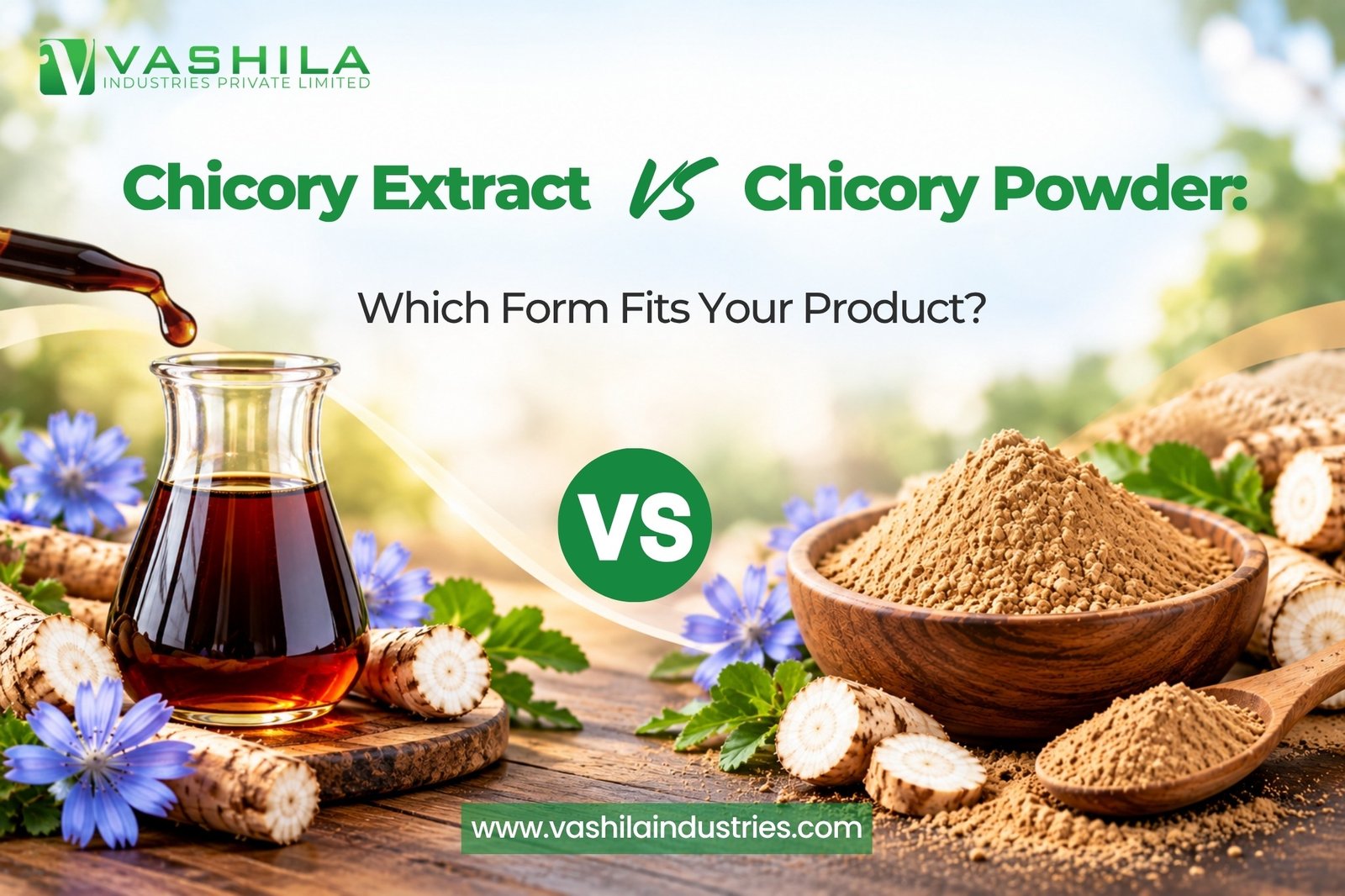
Chicory powder is the ground-up root. You take a chicory root, clean it, dry it (or roast it), and then mill it into a fine powder. That’s it. What you get is essentially the whole root in powdered form – fibre, flavour compounds, colour, minerals, everything that was in the root is still there.
Chicory extract is a concentrated product. The root goes through a hot water extraction process where the soluble compounds – primarily inulin – get pulled out, filtered, purified, and then either kept as a liquid concentrate or spray-dried into a powder. You’re left with a product that is engineered for specific functionality, not just ground-up plant material.
Think of it this way: chicory powder is like whole orange. Chicory extract is like orange juice concentrate. Same fruit, very different product.
The Head-to-Head Comparison Table
I know some of you just want the specs. Here’s the comparison that procurement teams keep asking us for.
Parameter | Chicory Powder | Chicory Extract |
How it’s made | Dried/roasted root → ground into powder | Hot water extraction → purification → liquid or spray-dried |
Inulin content | 25 – 45% (depends on roast level) | 60 – 95% (depends on grade) |
Solubility | Moderate – some sediment in liquids | High – dissolves cleanly |
Flavour | Strong roasted, coffee-like, slightly bitter | Mild to neutral (especially high-purity grades) |
Colour | Dark brown to black | Light amber (liquid) to white/off-white (powder) |
Texture contribution | Adds body, slight grittiness possible | Smooth, can mimic fat mouthfeel |
Main use case | Coffee blending, bakery flavour, beverage mixes | Fibre fortification, supplements, fat/sugar replacement |
Label perception | “Chicory powder” – sounds natural, traditional | “Chicory root fibre” or “Inulin” – sounds functional |
Typical MOQ | Lower – more accessible | Higher – due to extraction processing |
Price per kg | Lower | Higher (but higher potency per kg) |
Our product |
Quick note: We offer chicory powder in both roasted and instant variants, plus an unroasted chicory flour that sits somewhere between these two categories. Each one behaves a bit differently, so if you’re not sure which sub-type fits your application, just reach out.
When Chicory Powder Is the Right Choice
Let me be straightforward here. If your product needs flavour first and fibre second, chicory powder is probably what you want.
Coffee Industry – Still the Biggest Buyer
The coffee industry has used chicory powder for well over a century. South Indian filter coffee? That distinctive richness comes from blending roasted chicory with coffee beans. New Orleans-style café au lait? Same idea. The chicory adds body, reduces bitterness, and – let’s be honest – also brings the cost down because chicory is cheaper than coffee per kilo.
Our roasted chicory powder and roasted chicory granules are specifically produced for this market. We offer light, medium, and dark roast profiles because every coffee blender has their own preference. A light roast keeps more of the natural sweetness and a higher inulin level. A dark roast goes full-on smoky and caramelised, but you lose some inulin in the process.
Bakery and Dry Mixes
Here’s something I find interesting – more bakeries are starting to use chicory powder not just for flavour, but because it quietly bumps up the fibre content on the nutrition label. A roasted chicory powder at 25–40% inulin adds a meaningful amount of prebiotic fibre to bread, muffins, or energy balls without requiring any label that sounds “clinical” or “functional.” Consumers see “chicory powder” on the back of a granola bar and think “oh, that’s natural.” And they’re right.
Instant Beverages
Our instant chicory powder deserves a special mention. It’s spray-dried for full solubility – so it dissolves cleanly in hot water, no sediment, no grittiness. The inulin content runs higher too, usually 40–55%, because the spray-drying process is gentler than traditional roasting. RTD beverage makers and instant coffee brands tend to prefer this one over the standard roasted powder.
Bottom line: Chicory powder is your ingredient when the consumer is supposed to taste the chicory and benefit from the fibre as a bonus.
When Chicory Extract Is What You Actually Need
Now let’s talk about the other side. If your product needs fibre first and flavour is secondary (or even unwanted), chicory extract is the way to go.
Nutraceutical Supplements
This one’s obvious but worth stating clearly. If you’re putting chicory-derived inulin into capsules, sachets, or powder blends marketed as a prebiotic supplement, you need the concentrated extract – not the roasted powder. Nobody wants their prebiotic capsule to taste like coffee.
Our chicory extract in grain form delivers around 90% inulin. The liquid version sits at about 85% on a dry solids basis. These are the kind of concentrations that make sense for supplement dosing – a 5-gram serving gives you roughly 4.5 grams of pure prebiotic fibre. Try getting that from a powder at 30% inulin and you’d need 15 grams per serving, which creates all kinds of taste and texture issues.
Dairy and Plant-Based Alternatives
This is where the global inulin market has really taken off over the past few years. The market hit roughly USD 1.8 billion in 2024 and is projected to cross USD 2.7 billion by 2030 (Grand View Research).
Dairy manufacturers use chicory inulin extract as a fat mimetic – meaning it creates a creamy, smooth mouthfeel that lets you reduce fat content without making the product taste thin or watery (BENEO). Low-fat yoghurts, ice cream formulations, cream cheese alternatives – inulin extract works brilliantly in all of these. You can’t achieve the same effect with chicory powder because the plant fibre particles would create a gritty, uneven texture.
Plant-based milk brands have caught on too. Oat milk, almond milk, cashew milk – a lot of these products now use inulin as a fibre fortifier and mouthfeel enhancer. It’s one of those invisible ingredients that consumers never notice, but manufacturers swear by.
Sugar and Fat Reduction
Here’s a use case that keeps growing year after year. Food companies under pressure to reduce sugar and fat in their products are turning to inulin extract as a functional replacement. Inulin provides about 1.5 kcal per gram (compared to 4 kcal/g for sugar and 9 kcal/g for fat), and it contributes a mild, slightly sweet note that helps mask the flavour gap when sugar is removed (Healthline).
Protein bars, breakfast cereals, biscuits, sauces – I’ve seen chicory extract show up in reformulation briefs across all of these categories. And in every case, the manufacturer specifically needed the extract, not the powder. The reason? They wanted pure functionality without any roasted chicory flavour interfering with the existing taste profile.
Clean-Label Fibre Claims
One thing that surprises a lot of buyers: chicory inulin extract can be labelled simply as “chicory root fibre” or “inulin” on an ingredient list. Both names are consumer-friendly. Both sound natural. And regulatory agencies in the EU, US, and most Asian markets accept chicory inulin as a valid source for dietary fibre claims.
If your marketing team needs a “source of fibre” or “high fibre” claim on the front of pack, chicory extract gives you the highest fibre-per-gram ratio of any chicory product.
Bottom line: Chicory extract is your ingredient when fibre content and functional performance are the priority, and you need the chicory to stay invisible in the final product.
Can You Use Both in the Same Product?
Absolutely. And some of the smartest formulations I’ve seen do exactly that.
Think about a premium instant coffee product that wants to position itself as a “gut health coffee.” You’d use roasted chicory powder for the flavour base – that familiar, rich, slightly chocolatey note that consumers love. Then you’d add a small amount of chicory extract to boost the total inulin content high enough to support a “source of prebiotic fibre” claim on the label.
Same concept works for energy bars, breakfast biscuits, or functional drink mixes. Powder for taste, extract for numbers. It’s a smart one-two combination.
A Quick Word About Cost
I won’t pretend price doesn’t matter – it always matters. Here’s how I explain the cost difference to buyers who are trying to choose between the two.
Chicory powder is cheaper per kilogram. No question. The production process is simpler – you’re essentially drying and grinding a root. Minimal processing, minimal waste.
Chicory extract is more expensive per kilogram, but you’re getting 2–3x the inulin concentration. So when you calculate the cost per gram of actual inulin delivered, the extract often works out comparable – and in some formulations, it’s actually more economical because you need less of it to hit your fibre target.
Think about it this way. If you need 5 grams of inulin per serving:
- With powder at 35% inulin → you need ~14 grams of powder
- With extract at 90% inulin → you need ~5.5 grams of extract
That difference affects everything – your ingredient costs, your packaging, your serving size, your product weight. For a supplement brand producing millions of sachets, the extract makes way more economic sense even though the per-kilo price is higher.
The Decision Framework - Which One Do You Need?
Forget the technical specs for a second. Ask yourself these four questions:
- What’s the primary role of chicory in your product?
- Flavour and body → Powder
- Fibre and functionality → Extract
- Will consumers taste the chicory?
- Yes, and that’s the point → Powder
- No, it should be undetectable → Extract
- What fibre claim do you need on the label?
- None, or just a casual mention → Powder is sufficient
- “High fibre” or specific gram claims → Extract gives you the potency
- What’s your product format?
- Dry mix, bakery, coffee blend → Powder works great
- Capsule, liquid, yoghurt, bar → Extract performs better
If you answered a mix of both columns? Then you probably need both. And that’s fine – we supply them together all the time.
Why Vashila Industries for Both?
Here’s the part where I’ll be direct. Not many suppliers can offer the full range of chicory products – from dried roots all the way to 90% inulin grain extract – under one roof. We can.
Vashila Industries is a vertically integrated chicory processor. We grow it, we roast it, we extract it, and we ship it. Our facility holds FSSAI, ISO, HACCP, Kosher, Halal, and FDA certifications – which means our products clear customs smoothly whether you’re in Frankfurt, Dubai, or Chicago.
Every batch comes with a Certificate of Analysis. If you need custom specs – a specific inulin percentage, a particular particle size, a tailored roast profile – our R&D team will work with yours to dial it in.
What we offer:
- Roasted Chicory Powder – light, medium, dark profiles
- Instant Chicory Powder – fully soluble, higher inulin
- Unroasted Chicory Flour – for baking and fibre fortification
- Roasted Chicory Granules – coarser grind for specific applications
- Chicory Extract (Liquid & Grain) – 85–90% inulin
- Dried Chicory Roots & Roasted Chicory Cubes – for processors and extract manufacturers
Final Take
There’s no universal “better” option between chicory extract and chicory powder. There’s only the right option for your product, your label claims, and your consumers.
If you’re blending coffee or making a traditional beverage mix, chicory powder has been doing that job beautifully for over a century. If you’re formulating a prebiotic supplement, a fibre-enriched snack, or a reduced-sugar dairy product, chicory extract is the ingredient that was literally engineered for that purpose.
And if you’re still not sure? That’s what we’re here for.
Talk to our team – we’ll help you figure out which form, which grade, and which spec makes sense for what you’re building
Frequently Asked Questions
-
What's the main difference between chicory extract and chicory powder?
Chicory powder is the ground whole root - it retains the roasted flavour, colour, and moderate inulin content (25–45%). Chicory extract is a concentrated ingredient made through hot water extraction and purification, delivering 60–95% inulin with a mild or neutral taste. Powder is for flavour-forward applications; extract is for functional and nutritional applications.
-
Which has more inulin - chicory powder or chicory extract?
Extract, by a wide margin. Chicory extract in grain or powder form contains 85–95% inulin, while roasted chicory powder typically contains 25–40%. Even instant chicory powder tops out around 55%.
-
Can I use chicory powder instead of extract in supplements?
Technically possible, but not practical. You'd need 2–3x more powder per serving to match the inulin dose from extract, and the strong roasted flavour would dominate the supplement's taste profile. For supplements, extract is the industry standard.
-
Is chicory extract more expensive than powder?
Yes, per kilogram. But per gram of inulin delivered, extract is often comparable or even cheaper because of its higher concentration. The right choice depends on your formulation needs, not just the per-kilo price.
-
Does roasting destroy the inulin in chicory powder?
It doesn't destroy it entirely, but roasting does reduce inulin content by converting some of it into shorter-chain fructooligosaccharides (FOS). The darker the roast, the more conversion happens. Unroasted products like chicory flour retain more of the original inulin.
-
Where can I buy chicory extract and powder in bulk?
Vashila Industries supplies both chicory extract and powder in bulk to manufacturers worldwide. We're an Indian manufacturer with FSSAI, ISO, HACCP, Kosher, Halal, and FDA certifications. Contact us here for specs, samples, and pricing.