If you’re developing an instant coffee blend, a herbal drink mix or a sauce, you’ll hit this question early: do you buy chicory as an extract or as a powder? Suppliers use the words loosely, and the choice changes how your product dissolves, tastes, ships and keeps on the shelf.
The short answer is that dry blends usually suit a powder, and liquid or wet processes usually suit an extract. But there are a few details underneath that rule, including one that surprises many first-time buyers: conventionally roasted chicory carries far less inulin than the raw root. We’ll get to that below.
Quick definitions, because the names overlap
Three products get mixed up, so here is how we use the terms.
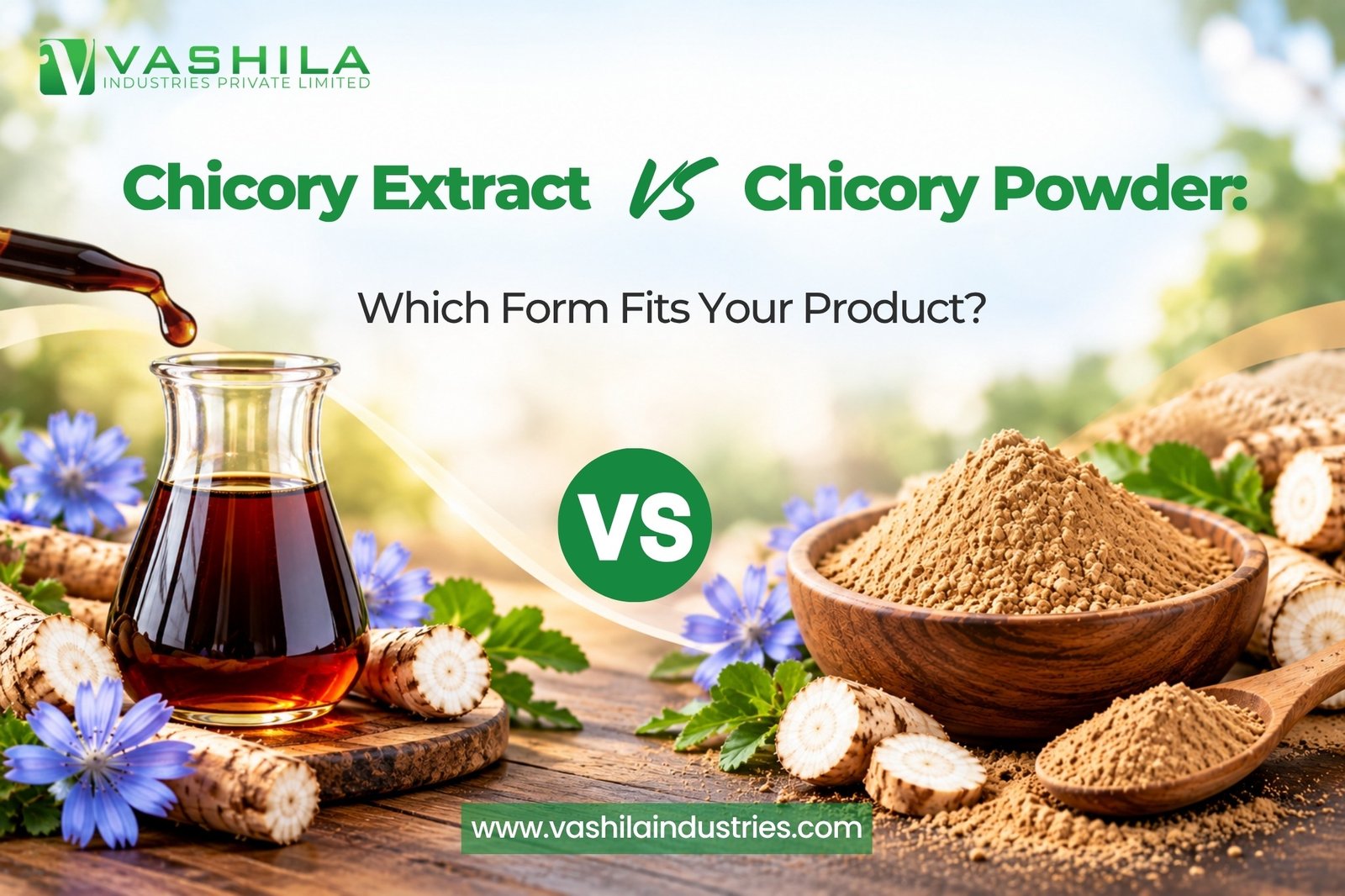
Roasted chicory powder is the root roasted and then milled. It’s the closest of the three to the plant itself. Instant chicory powder is roasted chicory that has been extracted with water and spray-dried into a soluble powder. Chicory extract is a liquid concentrate; ours is made from roasted chicory cubes.
Put another way, instant powder is basically extract with the water taken out. Patent literature describes the usual route in the same order: roast, extract with hot water, then dry the extract by spray-drying [1][2].
How each form is made, and why that matters to you
Roasting looks simple and isn’t. One patent notes that it’s hard to control, because smaller pieces roast faster and end up darker or burnt, while larger pieces can be darker in the core than on the outside [1]. For a buyer, that’s the reason cube size and roast consistency show up on a spec sheet. If you want to see the raw material before it becomes powder or extract, look at our roasted chicory cubes and roasted chicory granules.
Extraction and drying add more steps. In one example from that patent, dried chicory is extracted in water at 80 to 90 °C and the extract is then spray-dried with inlet air at 265 °C [1]. That’s one inventor’s example, not an industry standard, but it shows the scale of heat involved. The same document says that drying roasted chicory extract is awkward: the tower’s outlet air moisture has to be lowered, which cuts capacity, and material can build up inside the tower over long runs [1].
There’s also a chemistry point. Heat and moisture break inulin down into fructose and glucose during roasting and extraction [1][2]. Both patents link those sugars to powders that pick up moisture easily [1][2]. Keep that in mind when we reach storage.
Side by side
This table uses the details listed on our own product pages. Treat it as a starting point and ask for the Certificate of Analysis (CoA) for the batch you’re considering.
| Roasted chicory powder | Instant chicory powder | Chicory extract | |
|---|---|---|---|
| What it is | Roasted root, milled | Roasted, extracted, spray-dried | Liquid made from roasted chicory cubes |
| Form | Free-flowing powder | Free-flowing, fine powder | Dark brown to blackish liquid |
| Solubility as listed | “High solubility”, no figure given | Listed as 100% soluble, no sediment | Liquid concentrate, total solids at least 65% |
| Listed uses | Soluble coffee blends, chicory-coffee mixtures, instant beverages | Instant drink premixes, liquid extracts, instant coffee blends, dry-blending carrier | Instant coffee, beverages, bakery, confectionery, sauces, flavouring compounds |
| Packaging | Vacuum-packed in moisture-barrier bags or bulk liners | Multi-layer industrial export packaging | 20 FT containers for export, bulk drums for domestic orders |
| Minimum order | 13 MT | 13 MT per container | One 20 FT container, roughly 13 MT |
Solubility and handling in your plant
Instant chicory powder is the one listed as dissolving fully, with no sediment, fines or grittiness and no secondary filtration, in hot or cold premixes. The roasted powder page also mentions high solubility, but without detail, so if sediment matters in your drink, run a bench test with each.
The extract is a different kind of handling job. Our spec lists total solids of at least 65%, a pH of 4.2 to 4.7 and reducing sugar of no more than 29%. You’ll be pumping or dosing a thick liquid rather than scooping a powder, which suits plants set up for syrups, sauces or liquid beverage lines.
A bit of arithmetic helps with freight. At the minimum 65% solids, every tonne of extract is at least 650 kg of chicory solids and at most 350 kg of water. A container of roughly 13 MT therefore carries about 8.5 tonnes of solids at that minimum. You’re paying to move the water, but you’re also skipping the drying step.
Storage: powders and moisture
Powders are convenient, but soluble ones are fussy about humidity. A 2025 study in Foods tested instant coffee taken out of its pack at 20 °C. At 11% relative humidity it stayed stable. At 32% the powder held up in the short term, but the brewed drink’s pH had dropped noticeably after six months. At 65%, critical moisture levels were exceeded within a week, and within three months the powder looked visibly degraded, dissolved poorly and made a worse brew [3].
That study was on coffee, not chicory, so treat it as an analogy. Still, given what the patents say about chicory powders absorbing moisture [1][2], it explains why packaging matters. Ask your supplier how the product is packed, and keep opened bags sealed and dry.
Flavour, bitterness and the sugar question
Sugar level shapes taste. In one patent’s example, reducing sugars under 4% gave a sharp, harsh flavour, while 5 to 8% tasted mild [1]. That describes the inventors’ own product, so don’t use it as a benchmark for ours or anyone else’s. It does show why you should ask for the reducing-sugar figure and the basis it’s measured on.
Bitterness comes from compounds called sesquiterpene lactones. Another patent notes that less degradation of these compounds during roasting gives a more bitter result than conventional chicory [2]. In other words, roast profile moves flavour. Our instant powder page says the thermal profile can be adjusted toward a more bitter-sweet or smoky character on request, so tell us the taste you’re after.
What about inulin and fiber claims?
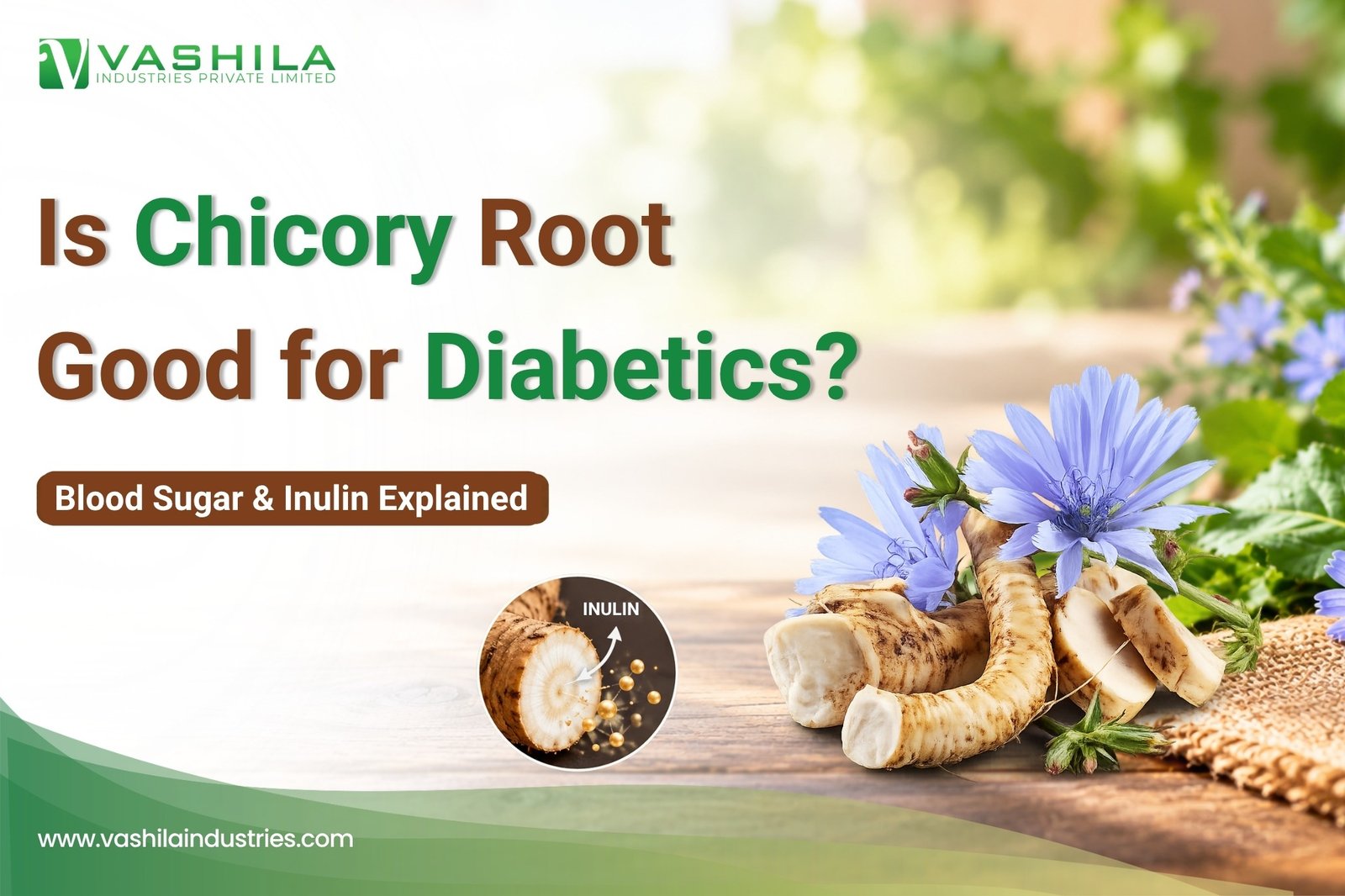
This is where buyers get caught out. Raw chicory root contains 70 to 94 percent inulin on a dry-weight basis [6]. Roasting and extraction change that. One patent says conventional processing can drive the inulin in soluble roasted chicory down, even to zero, and puts a conventionally made powder at about 18 to 19 percent, always under 20 percent [2]. That’s the applicant’s own description, not an independent test, so check an actual assay.
If a fiber or prebiotic angle matters for your product, the extract and the roasted powders probably aren’t your best starting point. Look at unroasted chicory flour, which skips the roasting step, and ask for an inulin assay of the specific lot. One more practical detail: inulin dissolves far better in hot water than in cold. A review puts solubility at roughly 6% at 10 °C and 35% at 90 °C [4], so cold drinks need testing.
Customs and paperwork
Roasted chicory and its extracts sit under the same international tariff subheading, 2101.30 [5]. One tariff catalogue (2024 edition) lists roasted chicory and extracts of roasted chicory as separate lines beneath it [5]. Codes vary by country and year, so confirm the right one for your destination with your customs broker. Per our product pages, shipments come with a CoA, a phytosanitary certificate and country-of-origin papers.
Which one fits your product?
This is our rule of thumb, based on the uses we list, not a law. Always test in your own formula.
- Instant coffee blend or dry beverage premix: start with instant chicory powder.
- A chicory-coffee mixture where you want body, color and roasted flavour from a ground ingredient: roasted chicory powder.
- Liquid beverages, sauces, bakery, confectionery or flavouring compounds: chicory extract.
- A fiber-focused product: unroasted chicory flour, with an inulin assay.
Questions to ask any supplier before you order
Ask for total solids or moisture, the reducing-sugar figure and its basis, an inulin assay if you plan to make fiber claims, the packaging and storage advice, and a CoA that covers microbiology. Then ask for a sample. We offer a free chicory sample so you can test before committing to a 13 MT order.
Common questions
Is chicory extract the same as instant chicory powder? Not quite. Instant powder starts as an extract and is then spray-dried [1]. The extract stays liquid.
Can I swap powder for extract one to one? No. The extract is a liquid with at least 65% total solids, so the amounts differ. Run trials and adjust.
Are these forms caffeine-free? Our pages describe the chicory products as caffeine-free. Confirm against the CoA for your batch.
What’s the minimum order? Our pages list 13 MT per container for the powders and one 20 FT container (roughly 13 MT) for export extract orders. Domestic buyers can ask about bulk drums.
Where to go next
If you’re still comparing, browse the full chicory range, send us your application through the contact page, or read more on our blog.
References
- US Patent 5,958,497. Chicory extract powder products and extract production processes and apparatus. https://patents.google.com/patent/US5958497
- US Patent 7,364,764 B2. Soluble roasted chicory having high inulin content. https://patents.google.com/patent/US7364764
- Lopriore M, Alongi M, Valentino M, Anese M, Nicoli MC. Impact of environmental humidity on instant coffee stability: defining moisture thresholds for quality degradation and shelf life prediction. Foods. 2025;14(10):1826. https://doi.org/10.3390/foods14101826
- Ahmed W, Rashid S. Functional and therapeutic potential of inulin: a comprehensive review. Crit Rev Food Sci Nutr. 2017. https://talcottlab.tamu.edu/wp-content/uploads/sites/108/2019/01/Inulins.pdf
- HS code 2101.30, roasted chicory and other roasted coffee substitutes, and extracts, essences and concentrates thereof (2024 edition). https://www.tariffnumber.com/2024/210130
- Ahrabi F, Ghassemzadeh HR. The effect of low pressure oven drying of chicory root on quality and extraction time of inulin. Biomechanism and Bioenergy Research. 2022;1(2):61–64. https://doi.org/10.22103/bbr.2022.20514.1028