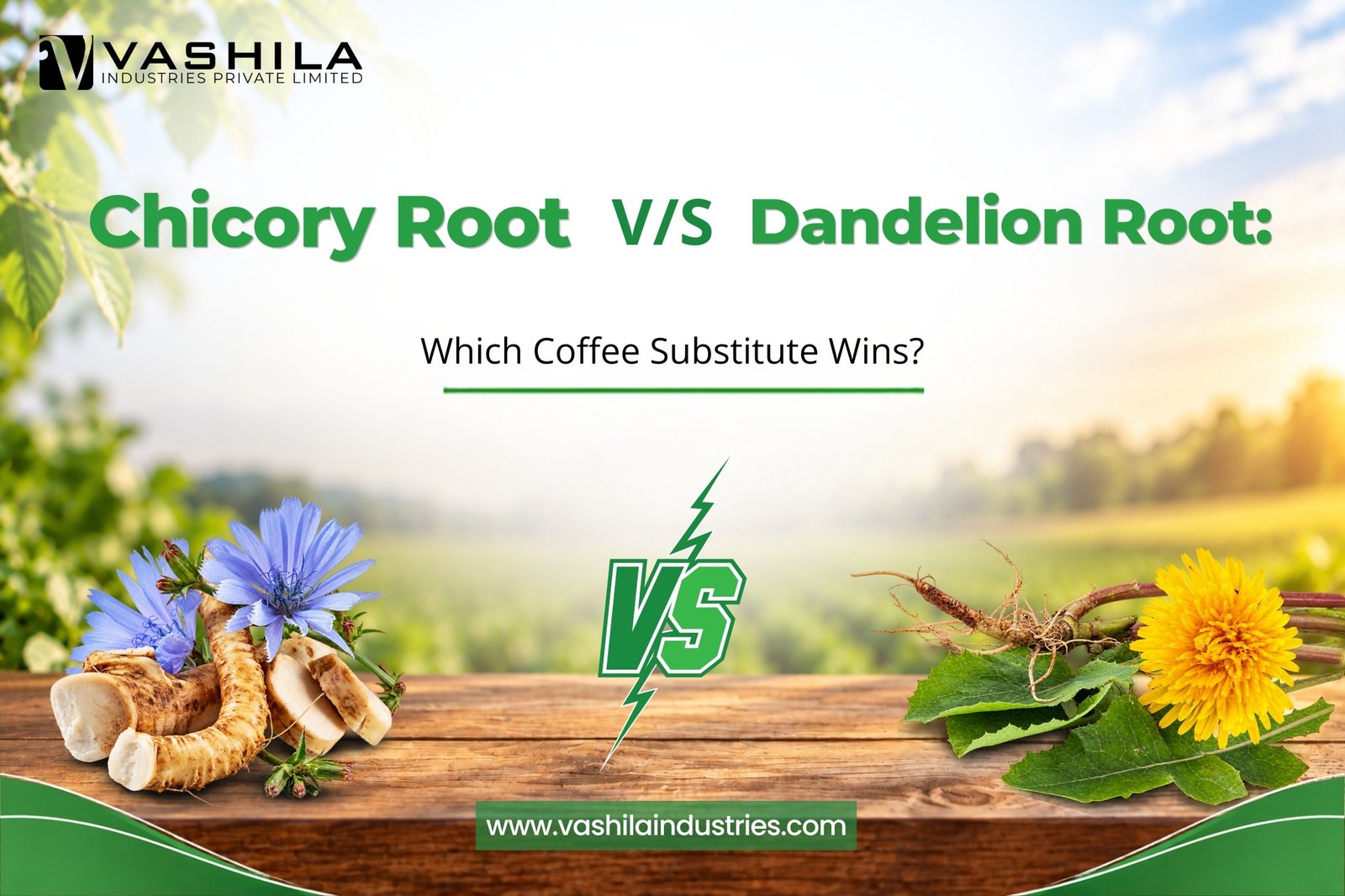
So you’ve decided to cut back on caffeine – or ditch it altogether – and now you’re staring at two options that keep showing up everywhere: chicory root and dandelion root.
Both are caffeine-free. Both are roasted and brewed like coffee. Both have been used for centuries. And both have passionate fans who’ll tell you theirs is obviously the better choice.
But here’s the thing – they’re not the same. Not in taste, not in nutrition, not in how well they actually mimic coffee, and not in how the food industry uses them. If you’ve been wondering which one deserves a place in your morning routine (or your product formulation), this guide will lay it all out – fairly, honestly, and without the hype.
First, What Do These Two Roots Have in Common?
Before we get into the differences, it’s worth noting why these two are always mentioned in the same breath:
- Same plant family. Both chicory (Cichorium intybus) and dandelion (Taraxacum officinale) belong to the Asteraceae (daisy) family (Britannica).
- Both are taproots. The commercially useful part of each plant is the thick, fleshy root that grows underground.
- Both contain inulin. Each root stores energy as inulin – a soluble prebiotic fiber – rather than starch, which is a trait common in the Asteraceae family.
- Both are caffeine-free. Neither root contains caffeine, making them naturally suited as coffee alternatives.
- Both are roasted and brewed. When dried, roasted, and ground, each root produces a dark, bitter, aromatic brew that loosely resembles coffee.
So far, so similar. Now let’s talk about where they part ways.
Taste & Flavour: How Do They Actually Compare in a Cup?
This is usually the first thing people care about – and it’s where the difference is most noticeable.
Chicory Root
Roasted chicory has a rich, full-bodied, woody flavour with noticeable notes of caramel and dark chocolate. It’s slightly bitter, but in a rounded, warming way – very close to the depth and mouthfeel of a dark-roasted coffee. This is exactly why roasted chicory powder has been blended with coffee for over 200 years – from South Indian filter coffee to New Orleans-style chicory coffee (Healthline).
If you’ve ever had a cup of coffee that felt smoother, less acidic, and somehow deeper than usual, there’s a good chance chicory was in the blend.
Dandelion Root
Roasted dandelion root produces a brew that’s earthier, lighter, and more mineral-forward. Think soil-like sweetness with subtle herbal and floral undertones. The bitterness is “cleaner” – less rounded than chicory, more akin to a mild herbal tea than a strong coffee (Cleveland Clinic).
Many people describe dandelion coffee as pleasant and soothing, but notably thinner in body compared to chicory.
The Honest Take
If your goal is to replicate the experience of drinking real coffee – the body, the richness, the bold roasted flavour – chicory root gets you much closer. Dandelion root is a lovely herbal beverage in its own right, but it doesn’t quite deliver that “coffee feel.”
For a deeper dive into how chicory performs as a coffee companion, read: Chicory vs Coffee: Differences, Benefits & Blending Uses.
Inulin & Prebiotic Power: The Gut Health Showdown
Both roots contain inulin, the non-digestible prebiotic fiber that feeds beneficial gut bacteria. But the concentrations are not equal.
| Metric | Chicory Root | Dandelion Root |
|---|---|---|
| Inulin (fresh weight) | 15–20% | ~12–15% |
| Inulin (dry weight) | Up to 58–68% | Up to ~30% |
| Commercial extraction | Primary global source | Rarely used commercially |
Chicory root is widely recognised as one of the richest natural sources of inulin on the planet – and it’s the dominant raw material used by the global food industry for commercial inulin extraction (Healthline; BENEO). A 2024 meta-analysis in The American Journal of Clinical Nutrition confirmed that chicory-derived inulin-type fructans significantly support weight management and gut health at doses of ~10 grams per day.
Dandelion root does contain meaningful inulin, but at notably lower concentrations – and there is no established large-scale extraction industry around it (Mountain Rose Herbs).
To understand how chicory’s prebiotic fiber is reshaping modern food products, see: Chicory Root Inulin for Clean-Label Functional Foods.
Health Benefits: Different Strengths
Both roots offer real health benefits – but they shine in different areas.
Where Chicory Root Excels
- Prebiotic gut health – Proven bifidogenic effect; promotes Bifidobacteria growth (NIH – PubMed)
- Digestive regularity – Clinically shown to relieve functional constipation at 12g inulin/day (WebMD)
- Weight management – Supported by a 2024 meta-analysis of 32 randomised controlled trials
- Blood sugar regulation – Minimal glycaemic impact; attractive for diabetic-friendly formulations
- Coffee replacement – Closest taste match of any caffeine-free alternative
For the full breakdown of chicory’s health benefits, read: What is Chicory? Uses, Benefits & Everything You Need to Know.
Where Dandelion Root Excels
- Liver support – Traditionally used as a liver tonic; believed to stimulate bile production and support the body’s natural detoxification pathways (Mount Sinai – Dandelion)
- Natural diuretic – Helps reduce water retention and bloating
- Vitamin and mineral density – Richer in vitamins A, C, and K, plus iron, potassium, calcium, and zinc compared to chicory (Cleveland Clinic)
- Anti-inflammatory potential – Contains taraxasterol and other compounds with antioxidant activity
Important Caveat
Many of dandelion root’s health claims – particularly around liver detox – are based on traditional use and preclinical (animal/lab) studies. Robust human clinical trials supporting these benefits are still limited. Chicory root’s prebiotic and metabolic benefits, by contrast, are backed by a larger body of published human clinical evidence.
Industrial Scalability & Availability
This is where the comparison becomes especially relevant for food manufacturers, coffee brands, and ingredient buyers.
Chicory root has a massive, established global supply chain. It’s cultivated commercially across India (Gujarat, Uttar Pradesh), Belgium, France, the Netherlands, and South Africa. It’s processed into multiple standardised formats – dried roots, roasted cubes, granules, powder, liquid extract, and unroasted flour – with internationally recognised certifications (FSSAI, ISO, HACCP, FDA, Kosher, Halal).
Dandelion root, by comparison, is mostly foraged or grown on a much smaller scale. There’s no equivalent industrial processing infrastructure for standardised dandelion root products. You’ll find it in health food stores and herbal tea brands, but sourcing it at scale – with consistent specifications, certifications, and supply continuity – is significantly harder.
Side Effects & Safety: What to Watch Out For
Both roots share some common cautions, unsurprisingly given their shared family:
| Concern | Chicory Root | Dandelion Root |
|---|---|---|
| Digestive discomfort | Gas, bloating at high doses (due to inulin) | Possible stomach upset, acid reflux |
| Asteraceae allergy risk | Yes – ragweed, marigold, daisy allergies | Yes – same family |
| Pregnancy | Possibly unsafe in large amounts | Insufficient safety data |
| Drug interactions | May affect blood sugar medications | May interact with diuretics, lithium, blood thinners |
| Gallbladder issues | May stimulate bile production | May stimulate bile – caution with gallstones |
Both roots should be introduced gradually into your diet. For chicory specifically, starting with 3–5 grams of inulin per day and building up slowly is the recommended approach (WebMD).
If you’re trying chicory for the first time, our beginner-friendly guide covers practical tips and what to expect: Chicory Root: A Complete Guide for Beginners.
Can You Blend Them Together?
Absolutely – and many people do. Combining chicory and dandelion root in a single brew creates a more complex, layered cup:
- Chicory provides the body, richness, and coffee-like depth
- Dandelion adds a clean, mineral brightness and herbal clarity
A popular ratio for a balanced brew is roughly 70% chicory to 30% dandelion, though you can experiment based on your taste preferences. Some commercial herbal coffee blends also add roasted barley, carob, or cinnamon for extra complexity.
For the recipe and brewing methods, check out: Chicory Root Coffee: Benefits, Side Effects & How to Make It.
Head-to-Head Comparison Table
| Factor | Chicory Root | Dandelion Root |
|---|---|---|
| Taste | Rich, full-bodied, caramel-woody | Earthy, light, mineral-herbal |
| Closest to real coffee? | ✅ Yes – widely used in coffee blends | ❌ Similar but thinner and more herbal |
| Inulin content | Very high (up to 68% dry weight) | Moderate (up to ~30% dry weight) |
| Prebiotic evidence | Strong (multiple human clinical trials) | Limited (mostly preclinical data) |
| Liver support | Mild | Stronger traditional reputation |
| Vitamin/mineral density | Moderate | Higher (vitamins A, C, K; iron, potassium) |
| Industrial availability | Excellent – global supply chain | Limited – small-scale, niche |
| Product format range | 7+ standardised formats | Mainly loose tea or powder |
| Certifications available | FSSAI, ISO, HACCP, FDA, Kosher, Halal | Varies – less standardised |
| Best for | Coffee replacement, gut health, food industry | Herbal wellness, liver support, tea blends |
The Verdict: So Which One Wins?
Here’s the honest answer: it depends on what you’re looking for.
Choose chicory root if:
- You want the closest possible substitute for the taste and body of real coffee
- Gut health and prebiotic fiber are a priority
- You need a reliable, scalable, certified ingredient for food or beverage manufacturing
- You want clinically supported health benefits
Choose dandelion root if:
- You prefer a lighter, more herbal, tea-like experience
- Liver support and micronutrient density are your primary goals
- You enjoy herbal wellness blends
Choose both if:
- You want the richest, most complex caffeine-free brew – chicory for body, dandelion for brightness
But if we’re being straightforward about which root has earned the title of the world’s go-to coffee substitute – through centuries of use, a global supply chain, a massive body of clinical evidence, and unmatched versatility in the food industry – chicory root wins that title clearly.
It’s not that dandelion root isn’t valuable. It absolutely is. But chicory root operates on a different scale – from a farmer’s field in Gujarat to a coffee cup in New Orleans, from a clean-label protein bar in Germany to an instant coffee factory in South India.
Looking for premium, export-grade chicory ingredients? Request a free sample from Vashila Industries – three generations of chicory expertise, delivered worldwide.
References & Citations
- Healthline. “Chicory Root Fiber: Benefits, Side Effects, and More.” healthline.com
- WebMD. “Chicory Root: Uses, Benefits, Side Effects.” webmd.com
- Mount Sinai. “Dandelion – Health Library.” mountsinai.org
- Cleveland Clinic. “Dandelion Tea Benefits.” health.clevelandclinic.org
- National Institutes of Health (NIH). “Inulin-type fructans and gut health.” pubmed.ncbi.nlm.nih.gov
- BENEO. “Chicory Root Fibre – Clinical Evidence.” beneo.com
- Britannica. “Chicory – Plant.” britannica.com
- Mountain Rose Herbs. “Dandelion Root Profile.” mountainroseherbs.com