I’ll be upfront about something before we get started. I run a chicory processing company in India – Vashila Industries. So yes, I have a horse in this race. But I’ve also spent enough years in international trade shows, buyer meetings, and factory audits to know that the “India vs Belgium” question isn’t as simple as picking the cheaper option. It never is.
If you’re a procurement manager for a coffee brand, a food technologist at a nutraceutical company, or an ingredient buyer scouting new suppliers – you’ve probably wrestled with this question already:
“Should we source chicory from India or Belgium?”
Both countries produce excellent chicory. Both have real strengths. And both have trade-offs that nobody in marketing will tell you about. So let me lay out the full picture – the good, the bad, and the stuff that only shows up after you’ve signed the contract and the first shipment lands at your port.
The Two Chicory Powerhouses - A Quick Background
Belgium: The Pioneer
Belgium didn’t just start processing chicory recently. This country has been at it for well over a century. Companies like BENEO (formerly Orafti), Cosucra, and Sensus have turned Belgium and the broader Benelux region into the global epicentre of chicory inulin production (BENEO).
These three companies actually formed something called CEFI – the European Association of Chicory Inulin Producers – to collaborate on regulatory standards, health claim research, and sustainability practices. That should tell you how deeply embedded chicory is in Belgium’s food ingredient ecosystem.
Europe as a whole accounts for roughly 40–42% of the global inulin market revenue, and Belgium sits right at the heart of that (Grand View Research). The focus here is overwhelmingly on high-purity inulin extraction – the kind used in nutraceuticals, functional foods, and pharmaceutical applications.
India: The Challenger That Caught Up
India’s chicory story is different. We didn’t start with inulin extraction labs. We started with coffee.
South India has been blending chicory into coffee for generations – it’s the secret behind the richness of a filter kaapi. That tradition built an entire chicory farming and processing industry, concentrated primarily in Gujarat (Jamnagar, Anand, Mehsana) and Uttar Pradesh (Etah, Kasganj). Together, these two states produce roughly 97% of India’s chicory (EIRI India).
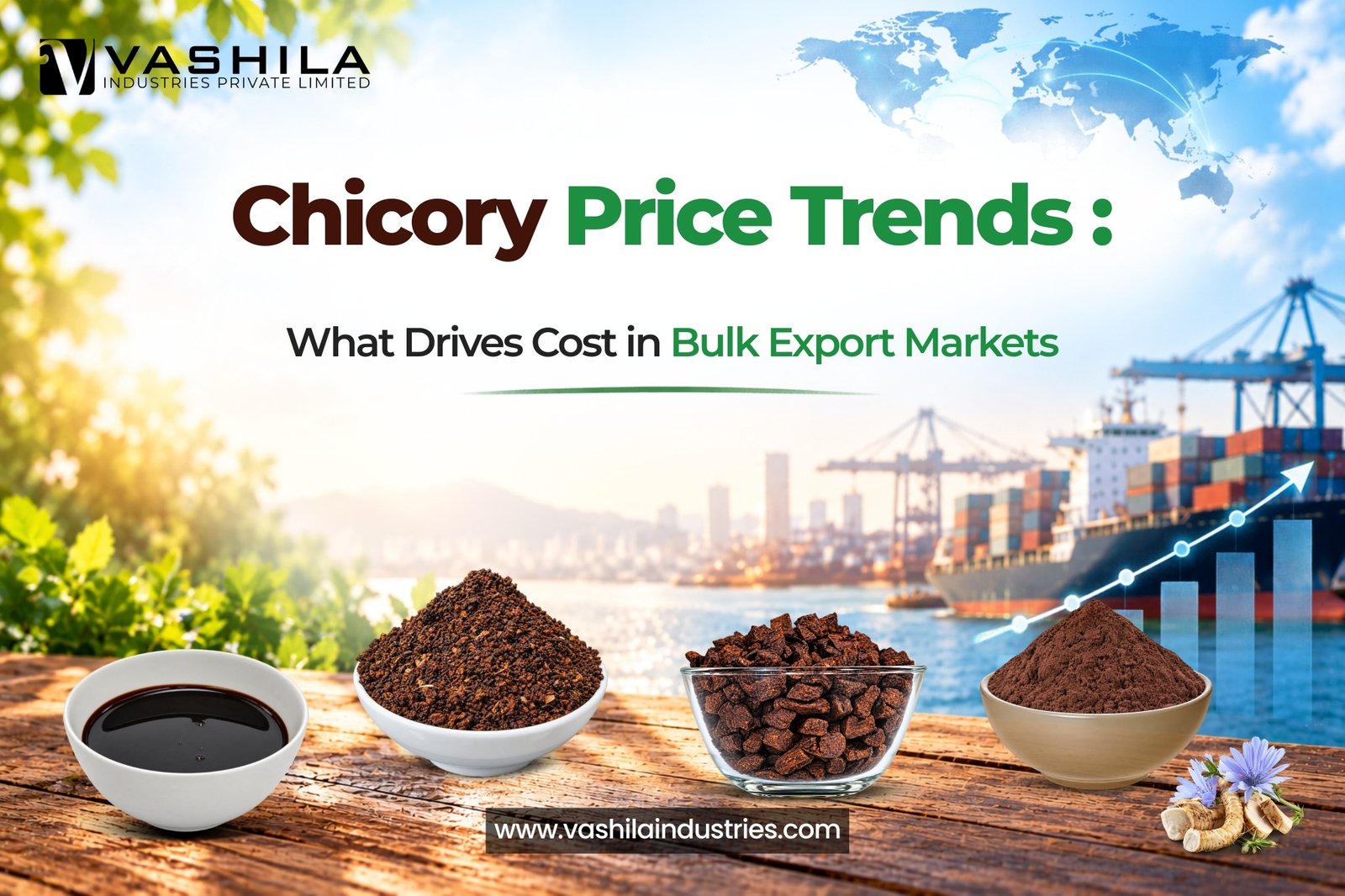
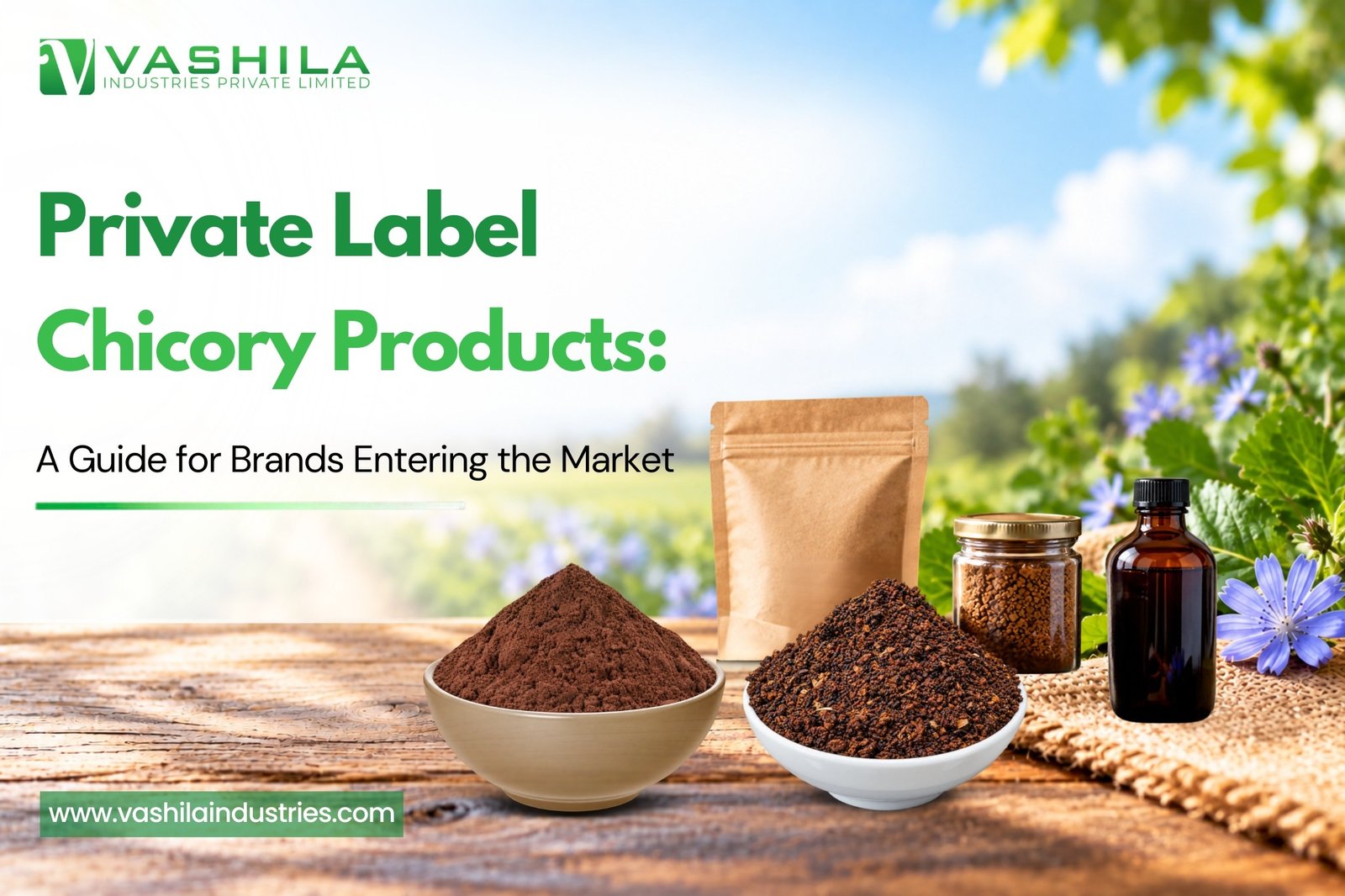
But here’s what changed. Over the past decade, Indian chicory processors – including us at Vashila Industries – invested heavily in food-grade processing facilities, international certifications, and product diversification. We’re no longer just supplying roasted chicory for coffee blends. We’re supplying dried roots, extracts, granules, flour, and everything in between – to buyers across Europe, North America, the Middle East, and Asia-Pacific.
India now accounts for approximately 47% of global chicory shipments by volume (Volza Trade Data). Let that sink in. By actual tonnage leaving ports, India ships nearly half the world’s chicory.
The Head-to-Head Comparison
Alright, let’s get to the part you came here for. I’ve organised this by the factors that actually matter when you’re making a sourcing decision.
Quality Comparison
Quality Parameter | Belgium | India |
Inulin content (dried root) | 35 – 45% (optimised cultivars) | 35 – 45% (comparable cultivars) |
Inulin content (extract) | 90 – 99% (pharma-grade available) | 85 – 95% (food & nutra-grade) |
Roast consistency | Extremely tight – computerised roasting | Very good – modern facilities available, varies by supplier |
Flavour profile | Smoother, more refined, milder | Bolder, more robust, deeper roast notes |
Colour uniformity | Highly consistent | Consistent with quality suppliers, variable with smaller ones |
Typical product focus | Purified inulin, FOS, specialty extracts | Full product range – roots, cubes, powder, granules, extract |
R&D investment | Very high – decades of published research | Growing – increasing investment in lab infrastructure |
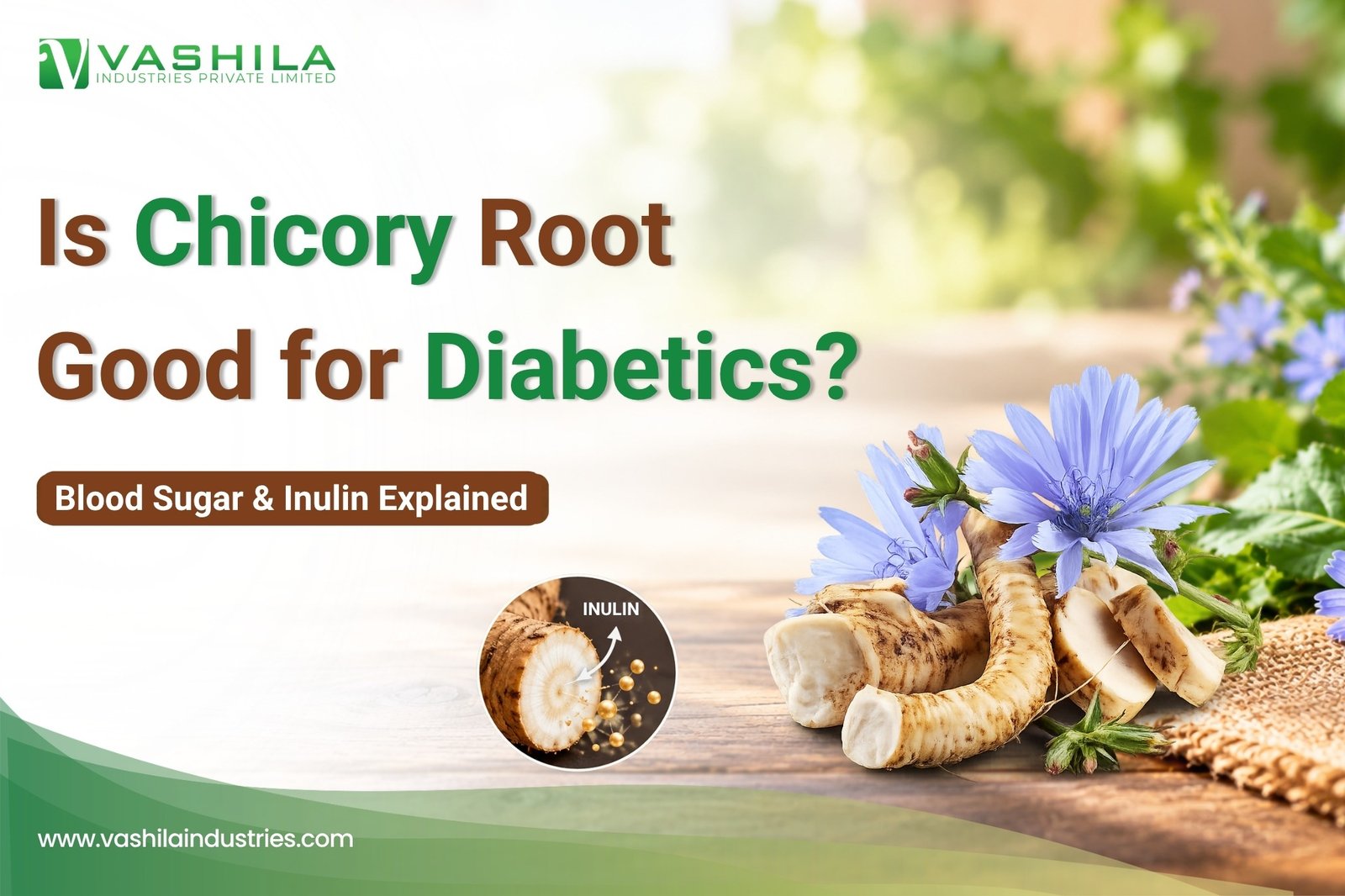
Here’s my honest take on this. At the raw root level, quality is remarkably similar. Indian chicory grown in Gujarat’s loamy soils regularly matches European roots in inulin content – we test our own chicory roots in every harvest, and the numbers consistently hit the 35–45% range on a dry weight basis.
Where Belgium still has a genuine edge is in ultra-high-purity extraction. If you need 99% pure inulin for a pharmaceutical application, Belgian processors like BENEO and Cosucra have decades of extraction R&D behind them. Their facilities are built specifically for that level of refinement.
But for food-grade, beverage-grade, and nutraceutical-grade applications? Indian chicory delivers comparable quality at a significantly better price point. And I’m not just saying that – our chicory extract tests at 85–90% inulin, which is more than sufficient for the vast majority of commercial applications.
Price Comparison
Let me be direct. This is where India wins, and it’s not even close.
Cost Factor | Belgium | India |
Raw material cost | Higher – European farming costs | Lower – Indian agricultural economics |
Processing cost | Higher – EU labour, energy, compliance | Significantly lower |
FOB price (dried root) | Premium tier | 30 – 50% lower than European origin |
FOB price (roasted powder) | Premium tier | 25 – 45% lower |
FOB price (extract) | Premium tier | 20 – 40% lower |
MOQ flexibility | Often rigid – large-scale operations | More flexible – wider range of order sizes |
Shipping cost to Asia/Middle East | Higher – longer transit | Lower – geographic advantage |
Shipping cost to Americas | Moderate | Comparable |
The price gap comes down to fundamental economics. Indian farming costs are lower. Energy is cheaper. Labour is more affordable. And our supply chain – from farm to port – is shorter and leaner.
Now, some buyers will argue that “you get what you pay for.” And there’s a version of that argument that’s valid – if you’re buying from an uncertified roadside processor in India, yes, quality will be inconsistent. But that’s a supplier selection problem, not an India problem.
When you source from a certified, vertically integrated processor like Vashila Industries, you get quality that meets international food safety standards at Indian pricing. That’s the real competitive advantage.
Supply Chain & Logistics
Supply Factor | Belgium | India |
Harvest season | Sept – Nov (single harvest) | Nov – Mar (longer window) |
Year-round supply | Yes – well-managed inventory | Yes – large processing capacity |
Lead time to EU | 1 – 3 days (road transport) | 20 – 30 days (sea freight) |
Lead time to Middle East | 7 – 14 days | 10 – 15 days |
Lead time to East Asia | 25 – 35 days | 15 – 20 days |
Lead time to Americas | 14 – 21 days | 25 – 35 days |
Supply scale | Consistent but smaller overall volume | Massive – India ships ~47% of global volume |
Geopolitical risk | Low | Low |
Geography matters more than people think in ingredient sourcing. If you’re a buyer in Dubai, Mumbai, or Singapore, shipping from India is faster and cheaper than from Belgium. If you’re in London or Frankfurt, Belgium is right next door.
But something interesting has been happening over the past few years. Even some European buyers have started splitting their sourcing – buying premium inulin extracts from Belgium for their high-end product lines, and sourcing roasted powder and dried roots from India for their volume products. It’s a smart dual-sourcing strategy, and we see it more and more.
At Vashila Industries, our facility in Gujarat is well-connected to Mundra and Kandla ports. We ship 20-foot and 40-foot containers regularly, and our logistics team handles documentation for customs clearance in all major destination countries.
Certifications & Compliance
This is one area where India has made enormous strides. Ten years ago, many Indian chicory processors lacked international certifications. That’s changed dramatically.
Certification | Belgium (Major Producers) | Vashila Industries (India) |
ISO 22000 / ISO 9001 | ✅ | ✅ |
HACCP | ✅ | ✅ |
FSSAI | N/A (Indian regulation) | ✅ |
FDA registered | ✅ | ✅ |
Kosher | ✅ | ✅ |
Halal | ✅ | ✅ |
BRCGS / IFS | ✅ (common) | In process / available by request |
EU Organic | ✅ (common) | Available with select cultivars |
Our facility at Vashila Industries holds FSSAI, ISO, HACCP, FDA, Kosher, and Halal certifications. These aren’t just stamps on a wall – they translate directly into smoother customs clearance, easier regulatory compliance for our buyers, and the peace of mind that comes from knowing the product was processed in a controlled, audited environment.
For buyers who need BRCGS or IFS certification specifically – reach out to us. We’re actively working on expanding our certification portfolio to meet those requirements.
Product Range Comparison
Here’s something that surprises a lot of buyers. Belgian processors tend to specialise in a narrow product range – primarily purified inulin and oligofructose. That’s what they’re built for, and they do it exceptionally well.
Indian processors like us? We offer the full spectrum.
Product Form | Belgium | Vashila Industries (India) |
Fresh/Dried Chicory Root | Limited | |
Roasted Chicory Root | Limited | |
Chicory Cubes (Dried & Roasted) | Rare | |
Roasted Chicory Powder | Limited | |
Instant Chicory Powder | Limited | |
Roasted Chicory Granules | Limited | ✅ Granules |
Unroasted Chicory Flour | Rare | |
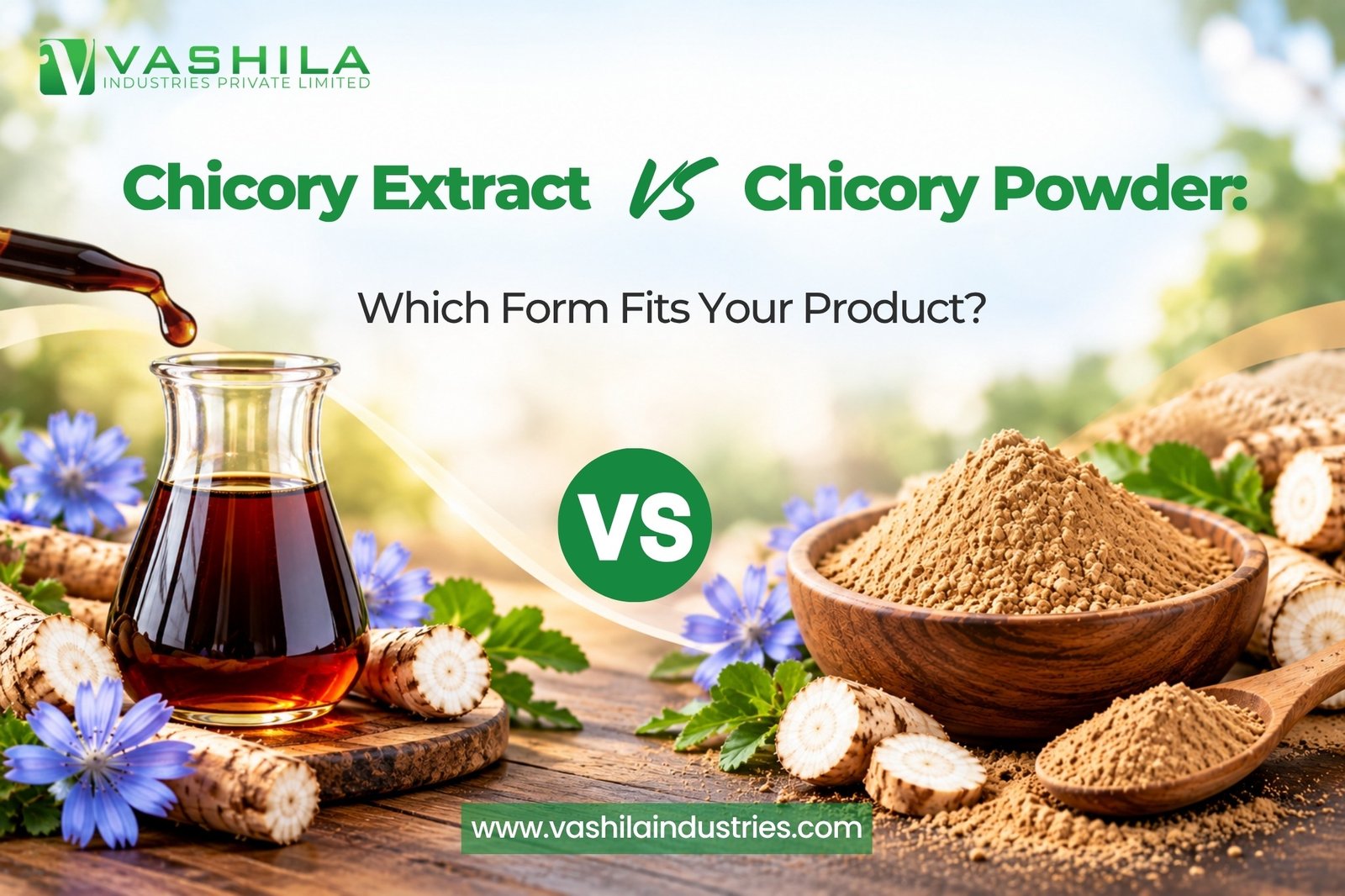
Chicory Extract (Liquid & Grain) | ✅ (primary focus) | |
Purified Inulin (95%+) | ✅ (primary focus) | ✅ (up to 90%) |
If you’re a buyer who needs multiple chicory product forms – say, roasted powder for your coffee blending line AND extract for your supplement range – working with a single Indian supplier simplifies your procurement massively. One supplier, one set of documentation, one quality relationship. That’s what our product range offers.
So… Which One Should You Choose?
I’ve been going back and forth in this article trying to be fair to both sides. So let me just give you my straight answer based on what I’ve seen in actual buying decisions.
Choose Belgium if:
- You need 99% pharmaceutical-grade inulin with decades of clinical validation
- Your product is positioned as ultra-premium European-origin and origin labelling matters to your consumer
- You’re based in Western Europe and prioritise overnight delivery with minimal logistics complexity
- You have a relationship with BENEO or Cosucra and it’s working
Choose India if:
- You need competitive pricing without compromising on food-grade quality
- You want a full product range – roots, cubes, powder, granules, flour, and extract – from one supplier
- Your end market is in Asia, Middle East, Africa, or you’re a cost-conscious buyer anywhere
- You value flexibility in order sizes, custom specifications, and roast profiles
- You’re looking for a vertically integrated supplier who controls the process from farm to shipment
Choose both if:
- You’re a large-scale manufacturer who wants to dual-source for supply security
- You use premium inulin in one product line and volume chicory powder in another
And honestly? More and more global buyers are landing in that third category. They’re not choosing between India and Belgium – they’re using both strategically.
Why Global Buyers Are Choosing Vashila Industries
I started Vashila Industries because I believed Indian chicory could compete with anyone in the world – not just on price, but on quality, reliability, and service. Here’s what we bring:
- Farm-to-Shipment Control: We don’t just buy and resell. We manage the full chain – farming, processing, testing, packing, and shipping.
- Lab-Tested Every Batch: Inulin content, moisture, ash, colour, microbial counts – everything documented in a Certificate of Analysis.
- 8+ Chicory Product Forms: From dried roots to 90% inulin extract, under one roof.
- Custom Specs Welcome: Light roast? Dark roast? Specific particle size? Particular inulin percentage? Tell us what you need.
- Global Certifications: FSSAI, ISO, HACCP, FDA, Kosher, Halal – export-ready for every major market.
- Proven Export Track Record: We ship regularly to buyers across Europe, North America, the Middle East, and Asia-Pacific.
The Bottom Line
The India vs Belgium debate isn’t about one country being “better.” It’s about which origin fits your specific needs – your product positioning, your price targets, your logistics, and your required specifications.
Belgium built the chicory inulin industry. That’s a fact, and they deserve full credit for it. But India has grown into a powerhouse that ships nearly half the world’s chicory volume, at quality levels that meet international standards, and at price points that European processors simply can’t match.
If you’re a global buyer still sitting on the fence, I’d say try both. Order a sample from Belgium and a sample from India. Test them side by side in your lab and in your formulations. Let the data decide.
And when you’re ready to source from India, Vashila Industries is here.
Frequently Asked Questions
-
1. Is Indian chicory as good as Belgian chicory?
For food-grade and nutraceutical applications - absolutely. Indian chicory roots from Gujarat and UP consistently test at 35–45% inulin (dry weight), matching European roots. The quality gap narrows every year as Indian processors invest in modern facilities and international certifications. Belgium still leads in ultra-high-purity pharmaceutical-grade inulin above 95%.
-
2. Why is Indian chicory cheaper than Belgian chicory?
It comes down to economics - lower farming costs, cheaper energy and labour, and a leaner supply chain. Indian chicory FOB prices are typically 25–50% lower than European equivalents, depending on the product form. The lower price does not inherently mean lower quality - certified Indian processors deliver products that meet the same international food safety standards.
-
3. Which country exports the most chicory?
India is the largest chicory exporter by volume, shipping approximately 47% of global chicory consignments (Volza). Belgium and the Netherlands lead in value terms, particularly for high-purity inulin and specialty extracts.
-
4. Can I source both chicory powder and extract from India?
Yes. This is actually one of India's strengths. Processors like Vashila Industries offer the full product range - from dried roots and roasted cubes to instant powder and concentrated extracts - making it possible to consolidate your chicory procurement with a single supplier.
-
5. What certifications should I look for in an Indian chicory supplier?
At minimum: ISO 22000 or ISO 9001, HACCP, FSSAI, and FDA registration. For Middle Eastern markets, Halal certification is essential. For European retail, Kosher and increasingly BRCGS/IFS are expected. Vashila Industries holds FSSAI, ISO, HACCP, FDA, Kosher, and Halal certifications.
-
6. How long does shipping from India take?
Sea freight from India's west coast ports (Mundra, Kandla) takes approximately 10–15 days to the Middle East, 15–20 days to East Asia, 20–30 days to Europe, and 25–35 days to the Americas. Container booking and documentation are handled by our logistics team.