For procurement managers and product developers, choosing the right chicory format is a critical decision. Whether you are manufacturing beverages, coffee blends, or food products, the form of chicory you select directly affects product performance, consistency, and production efficiency.
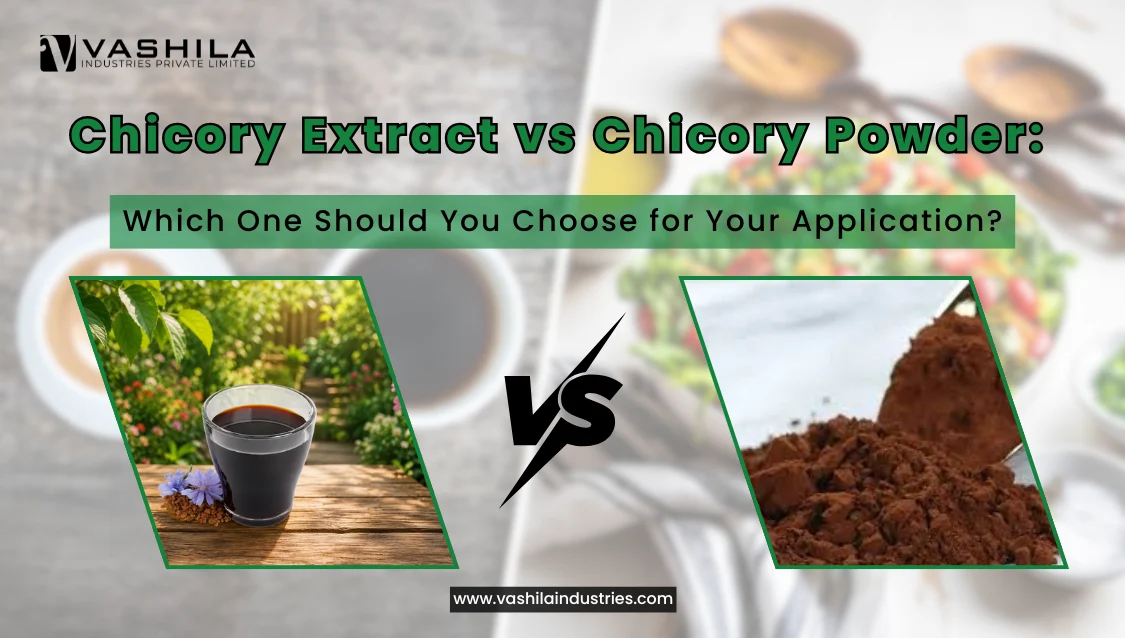
Among the most commonly used formats are chicory extract and chicory powder. While both originate from the same raw chicory roots, their processing, functionality, and applications differ significantly.
This guide will help you understand the difference and choose the right format based on your application.
Quick Answer
Chicory extract is a liquid or highly soluble form ideal for beverages and instant applications, while chicory powder is a dry form better suited for food processing and controlled formulations.
What Is Chicory Extract?
Chicory extract is a refined, high-performance ingredient created through the biochemical isolation of the soluble components of the Cichorium intybus root. Unlike raw agricultural products, the extract is a standardized concentrate designed for precision manufacturing.
The Extraction and Concentration Process
The production of industrial-grade extract begins with roasted chicory. These roasted pieces undergo a multi-stage aqueous extraction (often using a counter-current diffusion system). In this process, hot water circulates through the chicory to pull out the soluble solids, including:
Inulin: A soluble prebiotic fiber.
Sesquiterpene Lactones: The compounds responsible for the characteristic clean bitterness.
Volatile Aromatics: The “coffee-like” scents developed during roasting.
The resulting “liquor” is then filtered to remove 100% of the insoluble plant matter and concentrated through evaporation to a specific Brix density (typically 65%–70%) or spray-dried into a fine, instant-dissolve solid.
Key Industrial Characteristics
Total Solubility and “Zero-Sediment” Formulation: For liquid-based industries—such as RTD (Ready-to-Drink) beverages, syrups, and craft brewing—solubility is a critical quality metric. Chicory extract is 100% water-soluble. Because the filtration occurs at the source, it leaves no residue, grit, or “cloudiness” in the final product.
Concentrated Flavor and Color Standardization: Chicory extract serves as a potent natural colorant and flavor enhancer. It provides a deep, dark hue (measured on the EBC or Lovibond scale) and a concentrated, caramellic bitterness.
Automated Dosing and Processing Ease: Liquid extract can be integrated into automated production lines using standard dosing pumps, saving energy and eliminating factory-level solid waste disposal.
High-Yield Prebiotic Delivery: It is one of the most efficient ways to deliver Inulin for “Gut Health” claims without affecting the final product’s texture.
Primary Industrial Applications:
Instant Beverage Premixes: For 3-in-1 coffee and health drinks requiring immediate dissolution.
Ready-to-Drink (RTD) Formulations: Used in bottled cold brews, dairy-free milks, and botanical tonics.
Confectionery & Syrups: Providing natural color and bitterness to chocolate-based fillings and dessert toppings.
Nutraceuticals: Serving as a soluble fiber carrier for liquid supplements.
What Is Chicory Powder?
Chicory powder is a “whole-root” industrial ingredient produced through the mechanical processing of the Cichorium intybus plant. Unlike the extract, which isolates only soluble compounds, the powder retains the complete structural matrix of the roasted root, making it a vital component for applications requiring bulk, fiber, and heat stability.
The Roasting and Milling Process
The production of high-grade chicory powder is a precision-controlled thermal process. After the roots are cleaned and sliced into cubes, they undergo:
Uniform Roasting: The cubes are roasted in industrial drum roasters where the temperature is carefully modulated to manage the Maillard reaction. This ensures a consistent development of the nutty, toasted flavor profile and specific color values.
Precision Milling: The roasted cubes are pulverized in specialized mills. For industrial buyers, the mesh size is a critical specification—ranging from coarse grits for tea bags to fine, ultra-fine powders (60–100 mesh) for seamless integration into dry food bases.
Key Industrial Characteristics
1. Total Matrix Retention (Fiber & Bulk)
Because it is a ground product, chicory powder contains both Inulin (soluble fiber) and Cellulose/Lignin (insoluble fiber). This makes it an excellent “bulking agent” in food processing. It provides a structural mouthfeel that extracts cannot replicate, especially in meat processing or high-fiber bakery goods.
2. Thermal Stability and Controlled Release
Chicory powder is exceptionally heat-stable. In bakery applications, it maintains its aromatic profile and color even when exposed to high oven temperatures 180°C–220°C. Unlike liquid forms, the powder allows for a “controlled release” of flavor as it hydrates slowly within a dough or batter matrix.
3. Logistical Efficiency and Shelf-Life
From a procurement standpoint, chicory powder is the most stable format for global trade.
Ease of Transport: Being a dry, non-viscous solid, it can be shipped in standard multi-wall paper bags or jumbo bags without the risk of leakage associated with liquids.
Storage Stability: It has a superior shelf life (often up to 24 months) when stored in a cool, dry environment, as its low water activity prevents microbial growth.
4. Cost-Effective Formulation Base
For manufacturers of volume-heavy products like animal feed, pet food, or bulk coffee blends, chicory powder provides a more economical price per kilogram than refined extracts. It allows for high-volume usage while meeting nutritional and sensory targets.
Primary Industrial Applications:
Traditional Coffee Blending: Mixed with ground coffee beans to enhance body, reduce caffeine content, and provide a “mellow” bitterness.
Industrial Bakery & Biscuits: Used in dark breads, digestive biscuits, and cookies to improve crumb color and moisture retention (due to its hygroscopic nature).
Meat & Meat Analogues: Acts as a natural colorant and fat-replacer in sausages or plant-based meats, helping to mimic the appearance of cooked protein.
Seasoning & Spice Blends: Serves as a flow-stable carrier for dry seasonings, adding a savory “umami” undertone to soups and gravies.
Pet Food Industry: Highly valued for its prebiotic content (Inulin) to support digestive health in kibble and treats.
Chicory Extract vs Chicory Powder (Comparison Table)
Selecting the appropriate chicory medium requires an analysis of your production line’s hydration capabilities. While extracts offer chemical precision for liquid-state integration, roasted powders provide the structural fiber and thermal stability necessary for solid-matrix food engineering and dry-blend uniformity.
Feature | Chicory Extract | Chicory Powder |
Form | Liquid / semi-liquid | Dry powder |
Solubility | Instant | Requires mixing |
Flavor | Strong & concentrated | Balanced |
Usage | Beverages | Food processing |
Storage | Requires controlled conditions | Easy storage |
Handling | Liquid handling required | Easy to handle |
Ultimately, the choice hinges on your “Total Cost of Ownership.” Extracts reduce factory-level waste and processing time through pre-filtration, whereas powder remains the most cost-effective solution for high-volume dry formulations where fiber retention and bulk density are primary formulation goals.
When to Choose Chicory Extract
Chicory extract is the right choice when your application requires fast solubility and liquid integration.
Ideal for:
✔ Instant beverage manufacturing
✔ Coffee premixes
✔ Liquid food formulations
✔ High-speed production lines
Because of its quick dissolving nature, it reduces processing time significantly.
When to Choose Chicory Powder
Chicory powder is better suited for applications where dry processing and controlled blending are required.
Ideal for:
✔ Bakery products
✔ Dry mixes
✔ Snack seasoning
✔ Powder-based formulations
It offers flexibility in dosage and is easier to store in bulk.
Industrial Perspective: What Procurement Managers Should Consider
For a procurement manager, the choice between chicory extract and chicory powder is a strategic decision that ripples through the entire supply chain. While the raw material remains the same, the physical state of the ingredient dictates the efficiency of your production line and the final quality of your product.
Here is an in-depth expansion of the operational considerations for industrial procurement.
1. Production Process Compatibility
The primary concern is how the ingredient integrates with existing machinery.
Chicory Extract (Liquid/Paste): Ideal for closed-loop liquid processing. It bypasses the need for high-shear mixing or dissolution stages, making it a “plug-and-play” solution for breweries or bottling plants. However, it requires specialized pumping systems and stainless steel tanks.
Chicory Powder: Best suited for dry-blending operations. It integrates seamlessly into flour-based or granulated lines (like bakery mixes or instant coffee blends). The risk here is “clumping” or “dusting,” which can require dust extraction systems to maintain air quality and safety standards.
2. Storage Infrastructure & Shelf Life
Procurement must evaluate the Total Cost of Ownership (TCO) regarding warehousing.
Chicory Extract: Often requires temperature-controlled storage to prevent fermentation or degradation of active compounds like inulin. It is heavy and voluminous, increasing inbound freight costs.
Chicory Powder: Highly hygroscopic (absorbs moisture). It must be stored in climate-controlled, low-humidity environments to prevent caking. However, it is generally more shelf-stable and has a smaller physical footprint, allowing for higher pallet density in the warehouse.
3. Formulation Requirements: Solubility vs. Texture
The “functional” role of the chicory determines the format.
| Feature | Chicory Extract | Chicory Powder |
| Solubility | Instantaneous; perfect for clear beverages. | Requires heat or high-speed agitation to fully dissolve. |
| Fiber Content | Highly concentrated inulin (prebiotic) delivery. | Provides “bulk” and can act as a fat replacer in solids. |
| Flavor Profile | Often more intense/caramelized due to concentration. | Milder, providing a “mouthfeel” similar to cocoa or flour. |
4. Cost Efficiency & Scalability
While the price per kilogram may favor powder, the yield per unit tells a different story.
Chicory Extract Scalability: Because the extraction is already done by the supplier, you save on energy costs (no need for large-scale dissolution tanks). It is easier to scale “up” by simply increasing pump flow, but the unit price is often higher due to the supplier’s processing and water weight.
Chicory Powder Scalability: Offers a lower price point for high-volume commodity buying. However, scaling requires more labor (bag dumping) and potentially more equipment (industrial mixers).
5. Sector-Specific Preferences
Beverage Companies Focus on Chicory Powder
For RTD (Ready-To-Drink) coffees or functional elixirs, extract is king. It ensures a sediment-free product and maintains consistent “bitter-sweet” notes without the risk of particulate settling at the bottom of a bottle.
Food Manufacturers Focus on Chicory Powder
In the bakery, confectionery, and dairy sectors, powder acts as a functional filler. In gluten-free baking, for instance, chicory powder helps mimic the structural properties of wheat while boosting the nutritional profile (fiber) without adding excess moisture that could ruin a dough’s consistency.
The quality of both formats depends on how raw chicory is handled and processed. Learn more about how chicory root is processed.
Raw material quality also plays a role — explore chicory root harvesting.
For a complete overview of chicory applications, refer to the chicory guide.
Role of Multiple Chicory Formats
In real-world manufacturing, many companies use multiple chicory formats depending on product lines.
Chicory is available in various forms, including chicory powder, chicory grain, chicory cube, and liquid chicory, offering flexibility for industrial applications.
This reduces dependency on a single format and improves production efficiency.
Common Mistakes Buyers Make
Avoid these mistakes when selecting chicory format:
❌ Choosing based only on cost
❌ Ignoring solubility requirements
❌ Not testing application compatibility
❌ Overlooking storage limitations
Which One Is Better?
There is no universal “better” option.
- Choose chicory extract for speed, solubility, and beverage applications
- Choose chicory powder for flexibility, storage, and dry formulations
The right choice depends entirely on your production needs.
Chicory extract and chicory powder serve different purposes in industrial applications. Understanding their differences helps procurement managers make informed decisions that improve product quality and operational efficiency.
Selecting the right format ensures smoother production, better consistency, and long-term scalability.
Ready to elevate your inventory with the finest chicory extract or powder on the market? Partner with us today to secure a consistent, high-quality supply that supports your brand’s growth.
FAQ
What is the difference between chicory extract and chicory powder?
Chicory extract is a liquid form with high solubility, while chicory powder is a dry form used in food processing and dry blends.
Which is better for coffee manufacturing?
Chicory extract is generally preferred for instant coffee and beverages due to its quick solubility.
Can chicory powder be used in beverages?
Yes, but it may require additional mixing and may not dissolve as quickly as extract.
Which format is easier to store?
Chicory powder is easier to store because it does not require special storage conditions like liquid extract.
Why do manufacturers use different chicory formats?
Different formats are used to match application needs, improve processing efficiency, and ensure product consistency.