You can tell the difference the moment you step into the agricultural heartland of Gujarat.
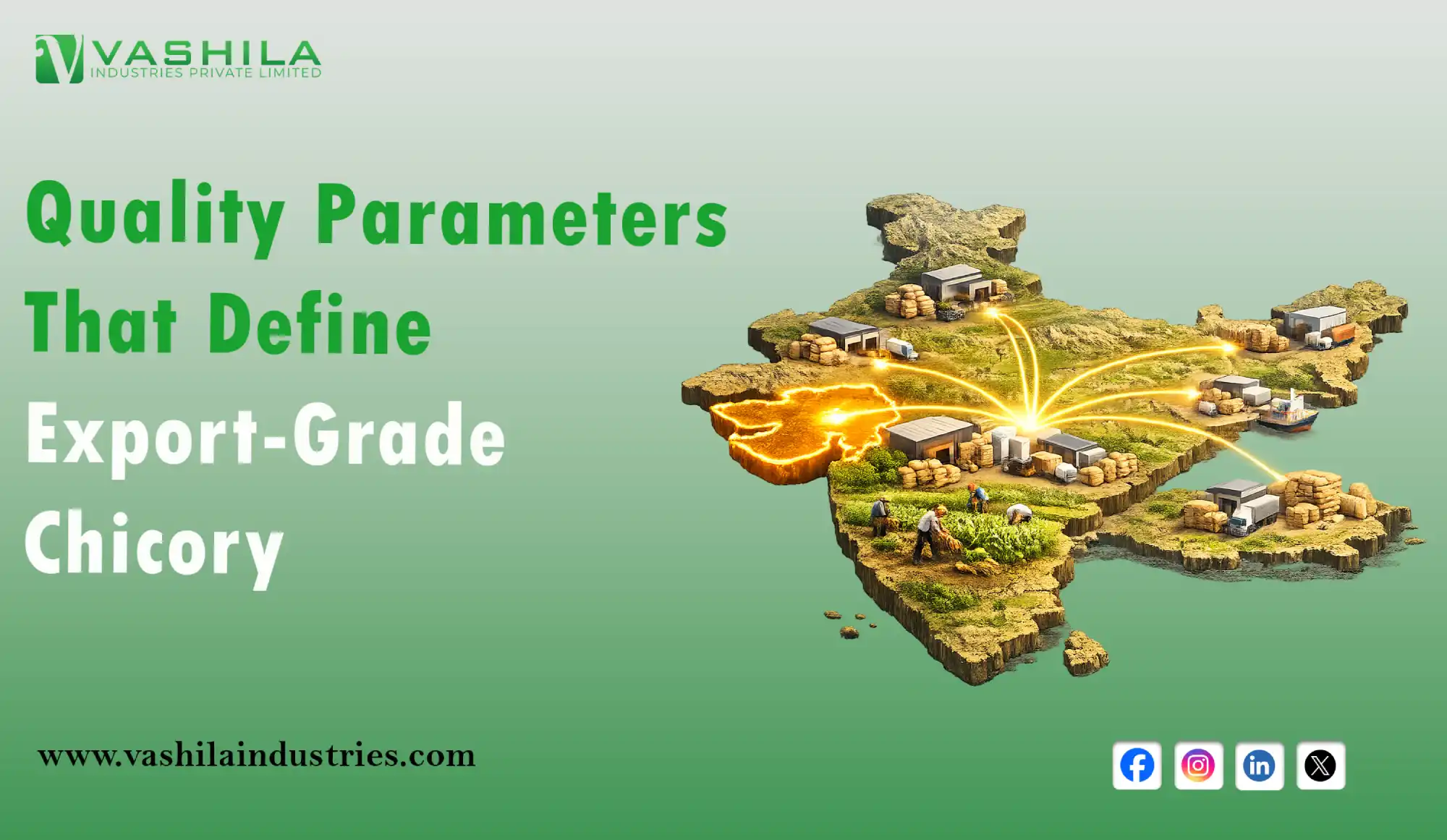
While the world knows India as a spice hub, we locals know Gujarat is the undisputed “Onion Bowl” of the country. From the fertile lands of Bhavnagar and Mahuva to our processing hub here in Nadiad, the air carries the promise of quality produce.
For B2B buyers and global food brands, this region is ground zero.
But here is the problem. You buy a container of dehydrated onions from a generic supplier, and it arrives looking wrong. Maybe the color is off. Maybe the moisture is too high, and you find clumps in the bag. You lose money, and worse, you lose production time.
We know that quality doesn't happen by accident. High-quality dehydrated onion products result from a rigorous, scientific manufacturing process. It’s engineering, not just cooking.
Vashila Industries
We want to take you on a tour. We will walk through our facility in Nadiad, showing you exactly how we turn a raw bulb into the shelf-stable ingredient that powers kitchens worldwide.
Stage 1: Sourcing the Raw Material – The Vashila Advantage
Great output requires great input. You can’t make premium flakes from bad bulbs.
Our process starts right at the farm gate. Situated in Nadiad, Vashila Industries is strategically located to source the best crops from Gujarat’s premium onion belts, specifically the Mahuva and Bhavnagar districts.
We look for two main things:
- High Solid Content: This is crucial for White Onions. Higher solids mean better drying ratios. It takes roughly 9 kilograms of fresh onion to make 1 kilogram of our dry product. If the solid content drops, the texture suffers.
- Pungency: Indian Red Onions are famous for this. They have a kick. Buyers in Europe and the US specifically ask us for this variety when they want that strong, authentic flavor profile in their spice mixes.
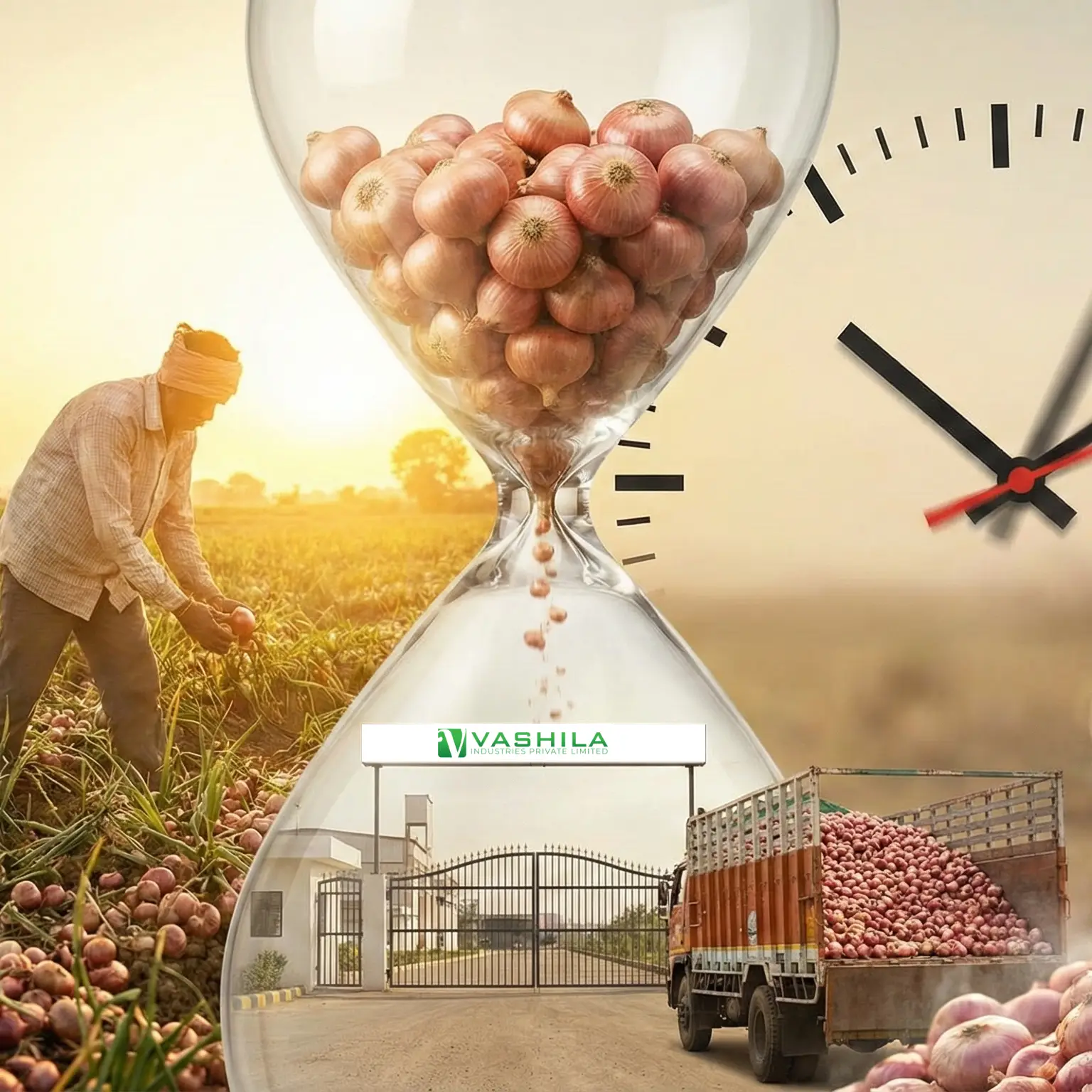
Time is the enemy here. Once a farmer harvests the crop, the clock starts ticking. We aim to get the raw material from the field to our factory gate in Nadiad rapidly. This speed preserves the organoleptic properties—the fancy term for taste and smell.
Buyers often ask about traceability. We track every batch. When you look at our Dehydrated Onion, you aren’t just seeing a catalog. You are seeing a choice made right here in the field.
Stage 2: The Pre-Processing Line (Hygiene & Preparation)
Now, we enter the factory.
This is the “wet” zone. Raw onions come in with soil, roots, and skin. We need to strip that away without damaging the flesh inside.
First, we grade them. Our team works alongside machines here. We remove any bulb that looks rotten or damaged. If it’s not perfect, it doesn’t make the cut at Vashila.
Next comes the peeling. We don’t do this by hand. We use automated systems—often flame peeling or abrasive peeling techniques. These machines strip the outer skin quickly and cleanly. It reduces waste and keeps the process fast.
Then, we cut the roots. Machines slice off the top and bottom of the bulb.
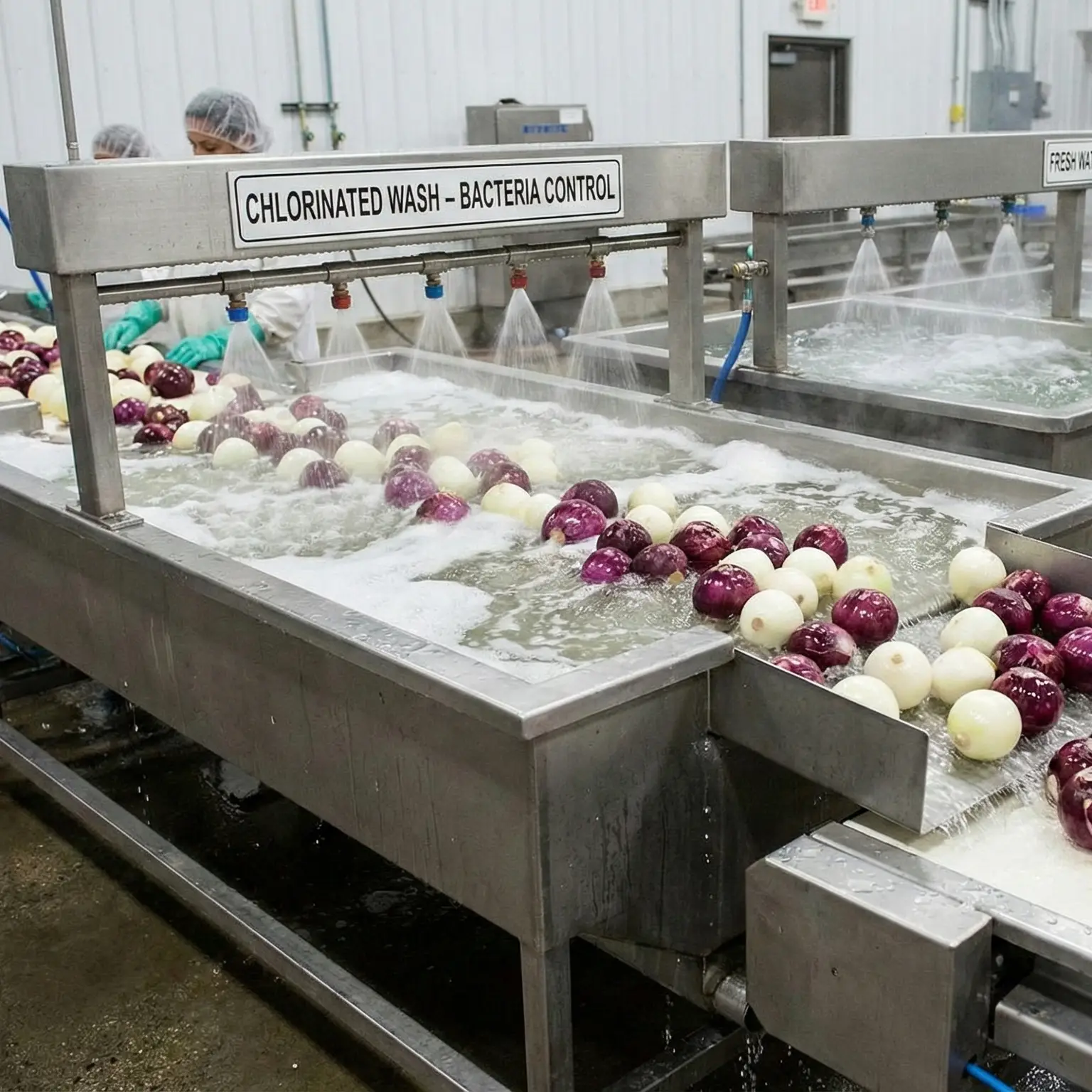
Finally, the wash. This is critical. We don’t just rinse them. The onions go through a multi-stage washing system. We use chlorinated water first to kill surface bacteria, followed by gallons of clean, fresh water to rinse everything away. By the time the onion leaves this section, it is pristine.
We follow a strict “Untouched by Hand” philosophy. Human contact introduces bacteria. Machines don’t. This ensures that what you eat is clean.
Stage 3: Perfect Slicing and The Dehydration Process
This is the heart of the Vashila operation. The dehydrated onion manufacturing process lives or dies in this room.
First, the slicer. Rotating blades cut the cleaned onions into uniform slices. Uniformity matters. If one slice is thick and another is thin, they will dry at different rates. That leads to burnt pieces or wet spots. We can’t have that.
The slices then move to the Imperial Continuous Dryer.
Imagine a massive, multi-stage conveyor belt system inside a heated tunnel. The onion slices ride these belts while hot air circulates around them.
We don’t just blast them with heat. That would cook the onion, and we don’t want cooked onion. We want dehydrated onion. We control the temperature strictly, usually keeping it between 50°C and 70°C.
The goal? Moisture control.
Fresh onions are about 85% water. We need to bring that down to 6-8%.
Why 6%? Because at that level, microbes can’t grow. The product becomes shelf-stable for up to two years. But we have to be careful. If we dry it too much, it turns into dust. If we leave too much water, mold grows. Our operators watch the moisture meters like hawks.
You can also read,
Stage 4: Milling, Grading, and Form Factors
The slices leave the dryer as “Kibbled” onions. They look like rough, dried petals.
For some buyers, the process stops here. But most of you need specific sizes. You need Onion Powder for a soup mix, or Minced Onion for a burger patty.
So, we send the product to the milling section.
Here, we grind and sieve the dried onions into specific sizes. We use vibro-separators—machines that shake the product through screens with different mesh sizes.
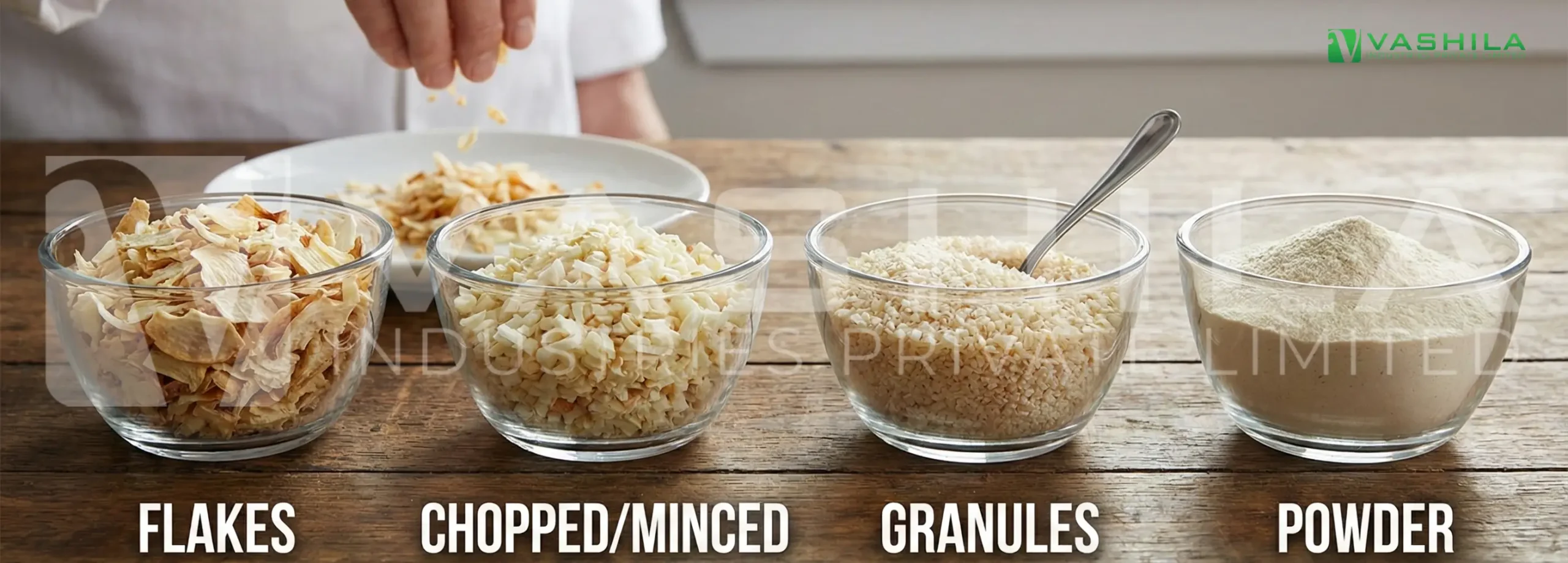
- Flakes: These are large pieces. You can see the texture. Chefs love these for visible garnish.
- Chopped/Minced: We cut these smaller. They rehydrate faster and blend well into sauces.
- Granules: Even smaller. Think of the texture of salt.
- Powder: We grind this into a fine dust (usually 80-100 mesh). It dissolves instantly.
It’s all the same onion, just a different cut. If you aren’t sure which one you need, our team can guide you on the best mesh size for your application.
Stage 5: Quality Assurance and Sterilization
You might think we are done. We aren’t.
Just because it’s dry doesn’t mean it’s ready for export. We have to prove it’s safe. This is where Vashila Industries separates itself from generic suppliers.
The product moves through an Optical Color Sorter. This machine uses high-speed cameras. It looks for anything that isn’t white (or red, depending on the batch). If it sees a black spot, a piece of peel, or a burnt flake, a jet of air shoots that piece out of the stream.
Then, magnets. Strong rare-earth magnets pull out any microscopic metal dust that might have come from the grinding machinery.
Finally, sterilization. This is vital for meeting global standards like BRC and ISO. We ensure the product is pathogen-free (Salmonella/E. Coli negative). We don’t ship a single bag until our lab confirms the Total Plate Count (TPC) is within safe limits.
Stage 6: Packaging and Logistics for Global Export
Moisture is the enemy.
If humid air touches our dehydrated onions, they will clump up like a brick. All that work in the dryer goes to waste.
We use a double-barrier system. First, we put the product in a strong poly-bag. This creates an airtight seal. Then, we place that bag inside a multi-wall paper bag or a strong corrugated box. This protects the product from physical damage and light.
Our warehouse in Nadiad stays cool and dry. When we load the shipping container, we inspect it for leaks. We seal it up, and off it goes to the port.
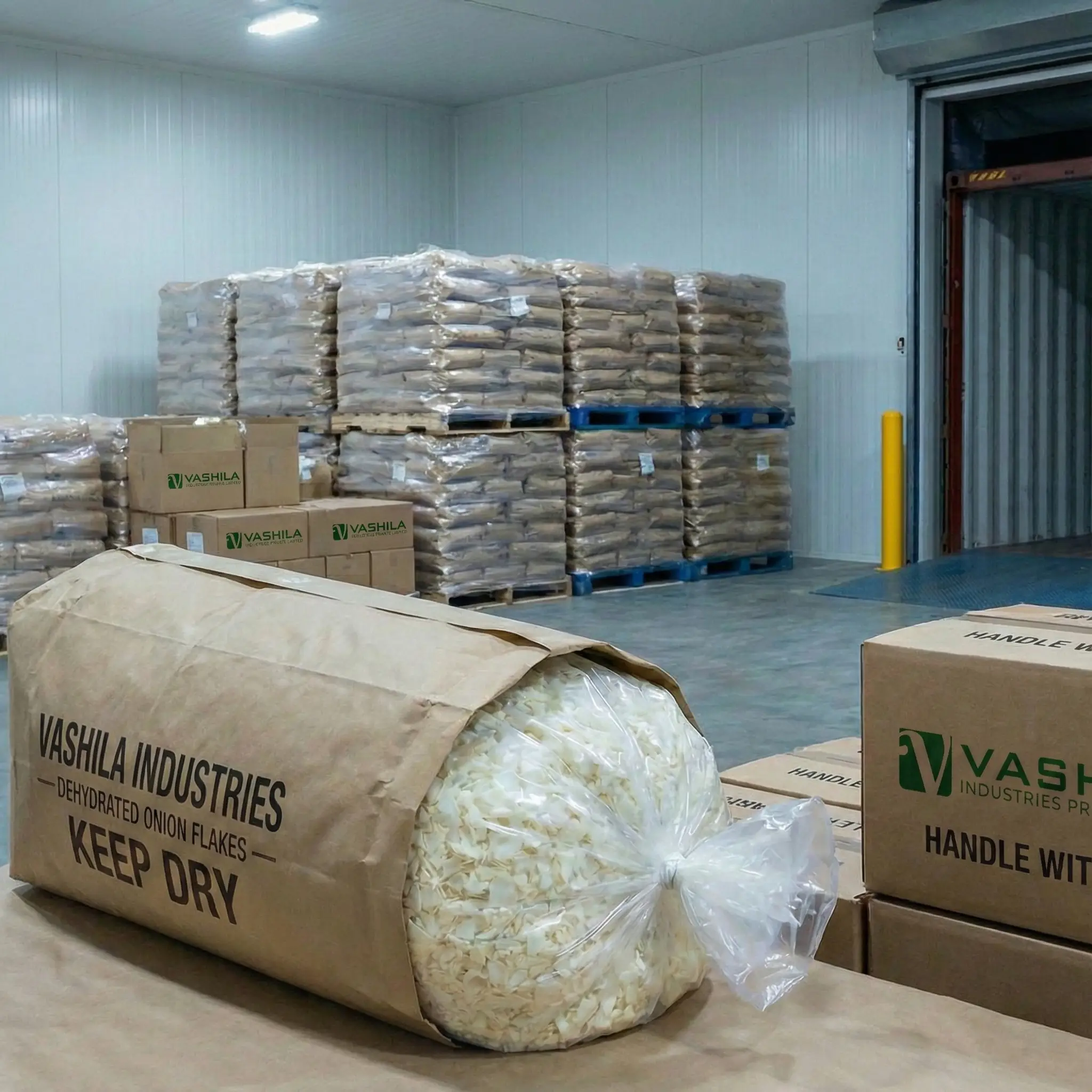
Here is a logistics bonus: Dehydrated onions save you money on shipping. Since we removed the water, the product is lightweight. You ship flavor, not water.
The Partner Supplier Vendor You Choose Matters
Manufacturing isn’t just about drying vegetables. It is a science of precision.
From the soil in Gujarat to the moisture sensors in our facility in Nadiad, every step affects the final taste. When you look for onion exporters in India, you need a partner who understands this technology.
You need a partner who invests in optical sorters, not just one who relies on cheap labor. You need a partner like Vashila Industries.
We believe transparency builds trust. That’s why we wrote this guide. We want you to know exactly what you are buying.
Looking for a reliable manufacturing partner for your private label or bulk ingredient needs?
Don’t compromise on quality. Contact us to get a quote for specific requirements or request a free sample kit of export-quality Dehydrated Onion Flakes and Powder. Let’s build a supply chain you can trust.