Chicory has evolved from a traditional coffee additive into a strategic ingredient used by coffee brands, FMCG manufacturers, and functional food companies worldwide. Its roasted flavor profile, caffeine-free nature, and formulation flexibility make it valuable across multiple applications—from coffee blends to clean-label food products.
This pillar guide provides a comprehensive overview of chicory, covering its products, processing methods, applications, and why India has emerged as a trusted global source.
What Is Chicory?
Chicory is a root-based crop cultivated primarily for industrial food and beverage use. When dried, roasted, or processed further, chicory develops a deep roasted character similar to coffee, without containing caffeine.
Today, chicory is widely used as:
A complementary ingredient in coffee blends
A base for caffeine-free beverages
A functional ingredient in food and nutrition products
Its versatility allows manufacturers to adapt chicory across multiple product formats and markets.

Chicory Products and Available Formats
Chicory is processed into various formats to suit different industrial requirements. Each format serves a specific purpose in formulation and production.
Roasted Chicory Products
Roasted Chicory Cubes – Used for controlled grinding and consistent blending
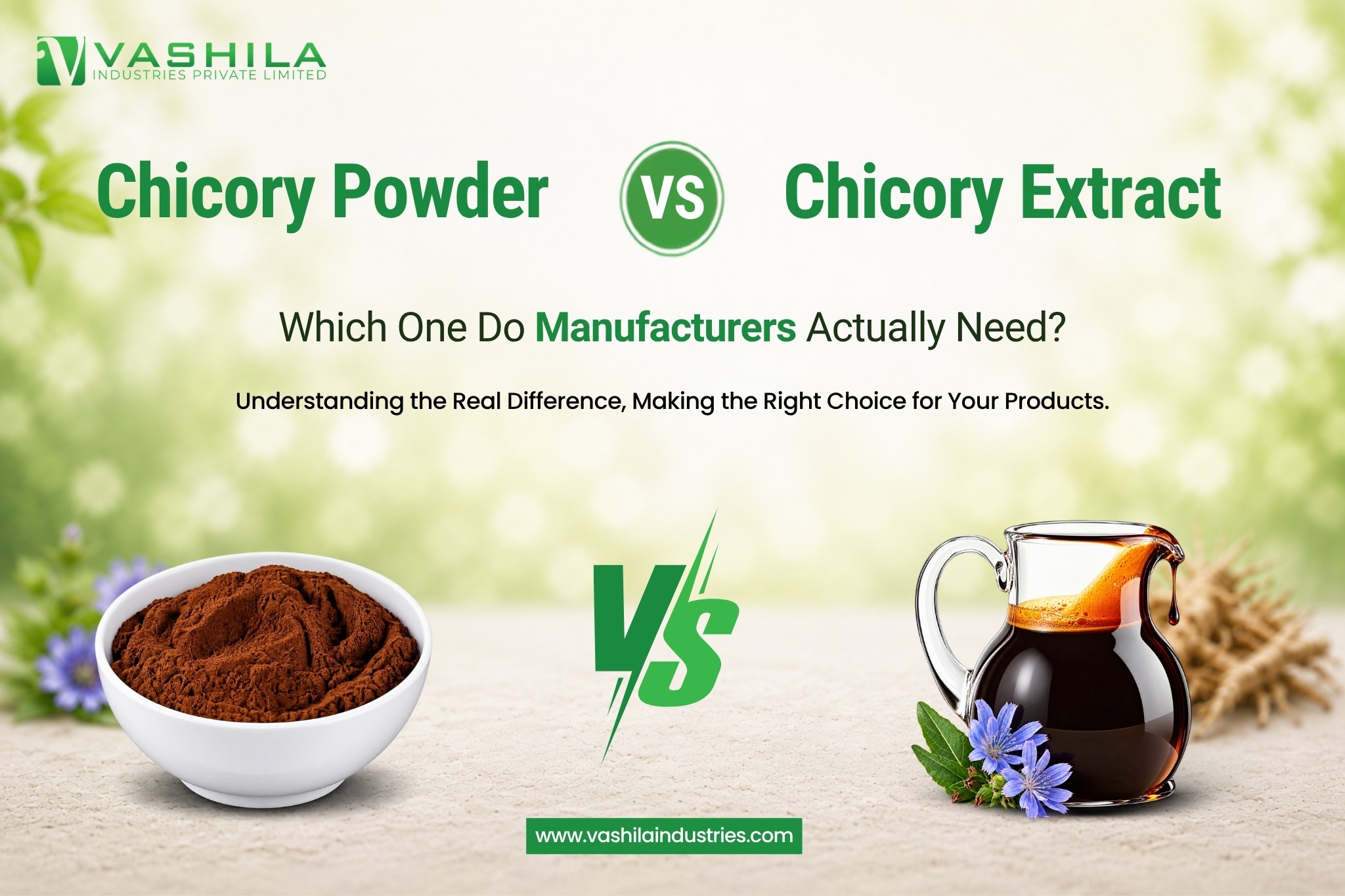
Roasted Chicory Powder – Ideal for instant beverages, sachets, and dry mixes
Granulated Chicory – Suitable for bulk blending and industrial use
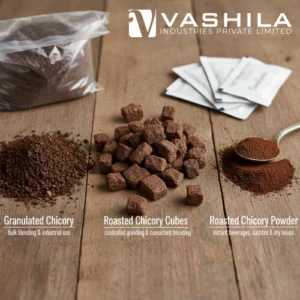
Explore how roasted chicory is used across coffee blends, beverages, and food applications in Roasted Chicory Benefits & Uses.
Chicory Derivatives
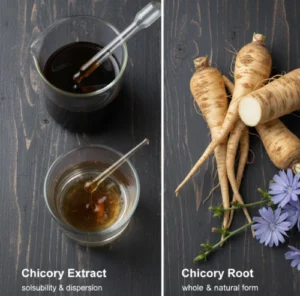
Chicory Extract – Used where solubility and dispersion are critical
Chicory Root Inulin – Applied in clean-label and functional food formulations
Together, these formats allow manufacturers to select chicory based on solubility, flavor intensity, processing method, and end-use application.
Chicory Products Available for Industrial and Export Applications
To support different processing, formulation, and market requirements, chicory is supplied in multiple product formats. Each format is designed to serve specific applications across coffee, beverage, and food manufacturing industries.
Below is an overview of the chicory products supplied in global markets:
Dried Chicory Roots – Used as the base raw material for roasting, extraction, and further processing
👉 Dried Chicory RootsChicory Powder – Suitable for instant beverages, coffee blends, and dry mix formulations
👉 Chicory PowderChicory Grain – Preferred for bulk blending, brewing, and controlled processing
👉 Chicory GrainChicory Cube – Used for uniform roasting, grinding, and consistent coffee blending
👉 Chicory CubeLiquid Chicory – Applied where solubility and dispersion are critical, especially in beverage formulations
👉 Liquid Chicory
How Chicory Is Processed: From Root to Finished Ingredient
Chicory processing is a multi-stage, controlled operation designed to ensure consistency, safety, and performance.
The process typically includes:
Cultivation and harvesting of mature chicory roots
Cleaning, sorting, and cutting
Controlled dehydration to reduce moisture
Roasting to develop desired flavor and aroma
Grinding or conversion into required formats
Quality testing and export-ready packaging
Each stage plays a role in defining the final product’s flavor profile, stability, and suitability for industrial use.
Learn how chicory is processed from raw root to finished ingredient in our detailed guide on Chicory Processing Explained.
Applications of Chicory Across Industries
Chicory’s adaptability makes it relevant across multiple sectors:
Coffee & Beverage Industry
Coffee blends to enhance body and manage caffeine levels
Instant and soluble coffee products
Caffeine-free coffee alternatives
FMCG & Food Manufacturing
Functional beverages
Bakery and cereal formulations
Clean-label product lines
Export & Bulk Ingredient Supply
Large-volume sourcing for international brands
Private-label and value-focused beverage products
Its ability to integrate smoothly into existing formulations makes chicory a preferred ingredient for scalable production.
See how Indian chicory is supporting U.S. coffee brands through formulation stability and supply reliability in “Chicory in the U.S. Coffee Industry“.
Chicory vs Coffee: A Strategic Ingredient Perspective
Chicory is not positioned as a replacement for coffee but as a supporting ingredient. While coffee provides aroma and stimulation, chicory contributes body, bitterness, and formulation stability.
Many brands use chicory to:
Balance flavor profiles
Reduce dependency on volatile coffee markets
Introduce caffeine-reduced product variants
Maintain cost predictability
This strategic use has increased chicory’s relevance in modern beverage formulation.
Understand the key differences between chicory and coffee, including taste, caffeine content, and blending applications, in Chicory vs Coffee.
Why Indian Chicory Is Trusted Globally
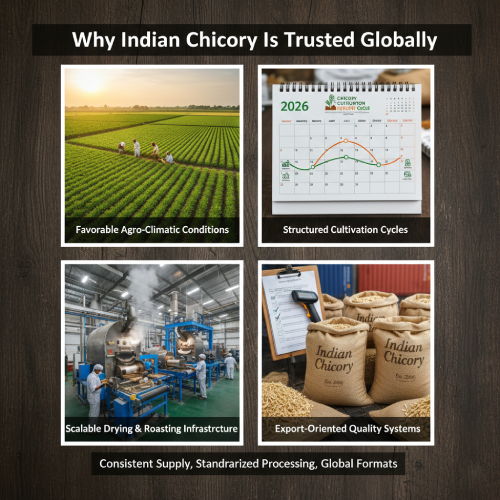
India has emerged as a reliable source of chicory due to:
Favorable agro-climatic conditions
Structured cultivation cycles
Scalable drying and roasting infrastructure
Export-oriented quality systems
Indian chicory suppliers support international buyers with consistent supply, standardized processing, and formats suited for global markets.
Discover why Indian chicory is gaining strong demand in international coffee and beverage markets in Indian Chicory in Global Markets.
Quality, Consistency, and Export Readiness
For global buyers, chicory sourcing decisions are driven by:
Batch-to-batch consistency
Food safety compliance
Shelf-life stability
Documentation and traceability
Controlled processing and quality checks ensure that chicory products meet international expectations for both food and beverage applications.
Learn how chicory root inulin supports clean-label food and beverage formulations in Chicory Root Inulin & Clean Label Foods.
Final Thoughts
Chicory has become a strategic, multi-application ingredient rather than a niche alternative. Its role in coffee blending, clean-label formulation, and global supply chains continues to expand as brands seek stability, flexibility, and innovation.
For global buyers sourcing chicory from India, evaluating product formats, processing standards, and supply reliability is a critical step. A structured understanding of chicory supports confident, long-term sourcing decisions.
Frequently Asked Questions
Is chicory naturally caffeine-free?
Yes. Chicory does not contain caffeine.
Can chicory be used alone or only in blends?
Yes, it can be used independently and also in combination with coffee.
Is chicory suitable for international export?
Yes. When processed under controlled systems, chicory meets global export requirements.
Are different chicory formats interchangeable?
No. Each format serves specific formulation and processing needs.